Showing posts with label World War II. Show all posts

Sunday, November 10, 2024

This England: Remembering the Veterans

Those of us in America may well have had parents or grandparents who served overseas in World War I or World War II, and many did not return home. But our country was not physically attacked. We may have had blackouts or rations, our men and women and working to support the war effort. But we were not bombed, with entire cities and towns being destroyed. Many in my own generation may or may not have served in the military. In Europe, it was a different story.


 On November 11, 1918, World War I ended. One year later in the U.S., president Woodrow Wilson introduced Armistice Day, which honored the end of that way. In the UK, Remembrance Day (or Poppy Day, because people wear red poppies that day) evolved from Armistice Day. It was during World War II that the name of the holiday was changed to Veterans Day in the U.S. Now we honor all veterans on this holiday. But many are remembered every day through memorials, and we saw many during our recent trip to England.

Wednesday, July 1, 2020

Paris In July: "Les Parisiennes"

"Paris in July" has returned! This terrific blog event features posts from loads of bloggers related to food, movies, books, music, travel, photos, art -- you name it! Check Tamara's site HERE for links to other participants. I tend to read and watch a lot of WWII history. It seems to be a period in time that is repeating itself all too soon in many parts of the world, but notably the United States. While I have read wonderful novels on the resistance, I'm not so familiar with the "real deal." Enter "Les Parisiennes," a non-fiction tome by Anne Sebba, which is fascinating, well written and well worth your time.


The subtitle of the book is "How the Women of Paris Lived, Loved and Died Under Nazi Occupation." And it delivers its promise.

"Les Parisiennes" follows women who were both resistantes and collaborators during the war, even some who tried to walk that center line -- not "really" collaborating but certainly not "resisting" the attentions of the German occupiers of Paris or what they might provide.

Although Sebba doesn't address it directly, it seems that an underlying theme is "what do you need to do to survive?" And, by extension, "What would you do in the situation."


In the book we meet women of incomparable bravery, those who would deliver explosives hidden under their shirts or beneath their baby in the pram; women who hid Allied soldiers and Jewish families; others who passed notes, messages and weapons. We also meet those sympathetic to the Vichy government, "friends" who sold out others.


The women in France weren't just the French. Sebba also looks at the women of the OSE, Britain's group of women who parachuted into the country, both for the purposes of spying and for assisting in the resistance.

Stories, many first person, tell of the round-ups from apartments and homes, the looting and confiscation of not only art but household goods from the Jewish homes, and the struggles for food during the occupation. They are harrowing but powerful, to see such tragedy -- and in some cases, survival.


The book follows a number of the political prisoners to Ravensbruck, the women's concentration camp where dreadful medical experiments were done on many of the prisoners. The chapters related to the camp are quite graphic -- and they should be. We must not forget.


 "Les Parisiennes" isn't your typical "summer reading." No carefree walks along the Seine, no picnics in the Tuileries. Yes, there is fashion (in fact, a good section of the book focuses on the Parisian fashion industry before and after the war). But by and large you won't turn the last page feeling cheery.

But you may well finish this well done book feeling hope -- that there were women who made a difference. And chances are, there will be women (and men) in the future who would do the same.


We must never forget them.

Wednesday, June 5, 2019

Commemorating D-Day

We all have the travel memories we will never forget. It may be the first glimpse of the Eiffel Tower, standing at the foot of a pyramid, looking at the vista from a mountaintop. For me, one that will stand forever is visiting Omaha Beach at the American Cemetery in Colville sur Mere, France, ten years ago this month.


As I stood on the beach and looked up the cliff that the Allied forces had to scale -- while being shelled and avoiding mines -- I was in awe. How in the world did they do it? What gave them the courage?


Ultimately, I think it was because those brave men believed in the cause. Did they know that millions of Jews, homosexuals, gypsies and resistance workers were being gassed by the Nazis? Maybe. Or maybe they were worried about any one country controlling such a significant amount of the world. Or perhaps those from England and France were simply defending their own homeland.


What matters is that thousands of brave young men fought and died for their beliefs and to preserve the values of world peace and tolerance, liberty and democracy.


I wonder what they would say now?

Those who remain for this 75th D-Day Anniversary are now largely in their 90s or older. It will be the last of the 25-year celebrations those veterans will attend. What do they remember, these once-young men? The fear? The camaraderie of being with their fellow soldiers? The fact that they were doing something to help their country and others preserve freedom?

It is easy to forget that those on the other side were also fighting for their country. They were conscripted and required to fight -- many didn't realize what was happening in Germany until it was too late to leave. I'm not sure every man fighting for the Nazis even fully knew or believed in what their leaders were doing. They may have been forced to fight or part of the mob-mentality and frenzy that often comes during polarized times. But these men had mothers and fathers, wives and children, just like the Americans and the Brits. Yet they were in the bunkers on Omaha Beach, shooting at others just their age, with wives and children. Shooting at those who were shooting back.


Are there really winners in war?


On this 75th anniversary of D-Day, I find it important not simply to look back but to look at today and tomorrow as well. Our national and world situation is as bad as it has ever been. When you look at the documentaries that tell of the advent of World War II, the footage is not all that dissimilar from what we see on our news each and every day.


People are divided more significantly than at any other moment in my lifetime, and I came of age during the Civil Rights movement. Strides made in this country in the post-war years have taken a huge hit. Xenophobic attitudes and religious intolerance, racism and the "Me first" attitudes have not just returned but increased. We fought for liberty and freedom and yet some seem quick to deny it to others.


We see it in day to day encounters. Bullying is on the rise in schools. People are angry. There is more lashing out. Less civility.


Even good people who do wonderful things may react in ways that do ourselves, our country, our world no good. We all know the people who faithfully attend church or do good works in their community and are first to help a friend in need. But then they will express racist views, privately or publicly, bully a co-worker or neighbor, will say hateful things. "Not in my neighborhood." "Not in our country." "Those people." Every word of intolerance builds a fence, indeed, a wall, that becomes more and more difficult to scale.


War and hatred doesn't begin with countries. It begins with us. Individuals. Our thoughts. Our deeds. The way we raise our children. The words we say -- in person, in print, tweeting or online. It begins with not listening to others, respecting and valuing others' opinions. Walking in our own shoes and forgetting to think about what it is like to walk in someone else's.

We aren't perfect but we have to try.


People die because of this. They die because someone believes their way is not just better but the only "right" way.  That someone may walk into a school and shoot innocent children or take out strangers in a parking lot or at a concert, perhaps feeling angry or slighted or simply because they were told to do so because in doing so, they were defending their rights. And then, people die. That someone may oppose a belief but not see that for others, the choice is different.


Changing attitudes can take time. It isn't easy. Honoring and respecting others who disagree with you can be hard thing to master. Some of us spend a lifetime trying. But trying is all one can do. Doing our best. Day by day. Grains of sand, each a thought. Letting them go so our hand can be open to something more beautiful.


Peace.


So, I ask you on this commemoration of D-Day, to look deep within, as I will do. To seek the "better angels of our nature." To think outside our own boxes, our own families and neighborhoods and look to others. Not just the others we know and understand, but especially those we don't. The poor. The mentally ill. The immigrants. Those whose beliefs are unlike ours but as valuable to them as ours are to us. Those we fought to protect on a grim, wet day seventy-five years ago.


And if you ask, "Why should I?" perhaps this image will remind you. It was a child I saw on Omaha Beach. One small child. One large beach. I don't know her name. I never spoke to her  and I never saw her again. But I will never forget her.


This is who I do it for. And all the others.


Everywhere.

(If you are into learning more about D-Day and the experience of visiting these sites, I recommend this beautiful article from The Atlantic. It's a keeper.)

Sharing with:    Pink Saturday     

Saturday, February 2, 2019

London: The Churchill War Rooms

This post is shorter than the great attention it deserves. It is a visit to one of my "must see" attractions and one of the best of our trip -- The Churchill War Rooms. (But at the very bottom you'll find a must-see link, one that is so well written and well photographed that it is a must for history, Churchill and WWII fans.)


We had started our day earlier with a trip to the Westminster Archives to find more information about my great grandmother and her parents. The archive center was located near Westminster Abbey, which was just a short walk from the Churchill War Rooms. We approached in the drizzle and this is what we saw.


But I was determined. This was our last opportunity to see the exhibits as the remainder of our time was planned in ways we didn't want to change. Besides, how long could it be?


(This is the one place where we should have bought our tickets online but we didn't really have a schedule). After awhile, Rick went to get sandwiches while I stayed in line and just about the time he got back, we moved near to the front and in the next go-round were admitted. (Admission includes the audio tour and wheelchairs are available, which was a good thing and one I took advantage of. The more my foot was in pain, the more that my embarrassment of using them had, by now, dwindled.)


One goes underground. This is where Winston Churchill and his key advisors did their planning and discussions of WWII. If you saw the film "The Darkest Hour," you will be familiar with the idea that Churchill and his team were often in this underground bunker.


It is a labyrinth of rooms that includes offices for individuals...


...a broadcasting studio...


...a bedroom for the Prime Minister...


...The secretary pool...


And a full kitchen.


The map room is presumably left as it was, filled with enormous maps that with push pins chronicled the moves of the Allied Forces.


The audio tour was reverent -- and irreverent, highlighting both the lows and highs of working with the effusive Prime Minister.


I would have thought I would be quite happy simply with the reconstructed rooms, but the museum provides much more than this. In addition to these historic spaces is a comprehensive museum on the life of Winston Churchill.


Included are numerous films and videos, interactive exhibits (the one that followed his passionate interest in painting was especially fun) and personal artifacts.


Of particular interest to me was the beautiful correspondence between Churchill and his wife, Clementine.


Another treasured piece, a handwritten from George VI.


The light here wasn't the best and as I was wheeled along it was often difficult to get good photos. But there was so much good material that photos weren't really my priority at the moment.


The printed materials for the museum/war rooms suggest at least 90 minutes. If you are one who really appreciates history, I would recommend something more like three hours.


We were close to closing time and had to rush a bit at the end. I would be inclined to return, just to take things in a little longer and at a more leisurely pace. besides, I like to read all the letters and watch much of the film. (And I think we were there probably at least two and half hours.)


If you head to the War Rooms, and fancy a snack or a sip after, you might want to try Two Chairmen, which is a block away. No, we didn't go there because we didn't really know about it but after reading Mike's post about it on A Bit About Britain, it was just the kind of pub we would have loved to find! And while you're at Mike's blog, check out his outstanding post HERE on the War Rooms. (If I had told you there was a MUCH better post about this fabulous attraction, with better photos and even more intriguing history at the top of this post, you never would have made it to here!)

Sharing with:    Take Me Away!    /     Timeless Thursdays    

Wednesday, July 8, 2009

Normandy: Sobering, Beautiful

One of the places I had longed to visit in France was Omaha Beach and the Norman countryside. And, I must admit, my reasons for doing so were both historical and personal.

Several years ago, WKAR produced two World War II documentaries, one of which focused on the European theatre. During the course of production, I edited transcripts of many veterans who had served and shared their experiences. (You can see them here if you're interested.)

Several spoke of D-Day and Normandy and the coastal towns they lived and fought in following the invasion. It had indeed become personal.

Our trip to Normandy began early on a Sunday morning, with a fairly long drive, punctuated by stops at town "foires" -- a combination of town flea market and fair with rides and food.

(More on these in another post on flea markets, but I had some fun finds!)

Our first destination was the Omaha Beach Museum. It was fairly small, but with lots of artifacts, clippings, photographs and life-size diarama scenes.

The pieces in the museum told the story --

...from the landing to the resistance.

The emphasis wasn't on the equipment used (although there were certainly examples of the various arms and mortars, uniforms and helmets),

... but of the people who fought so bravely.


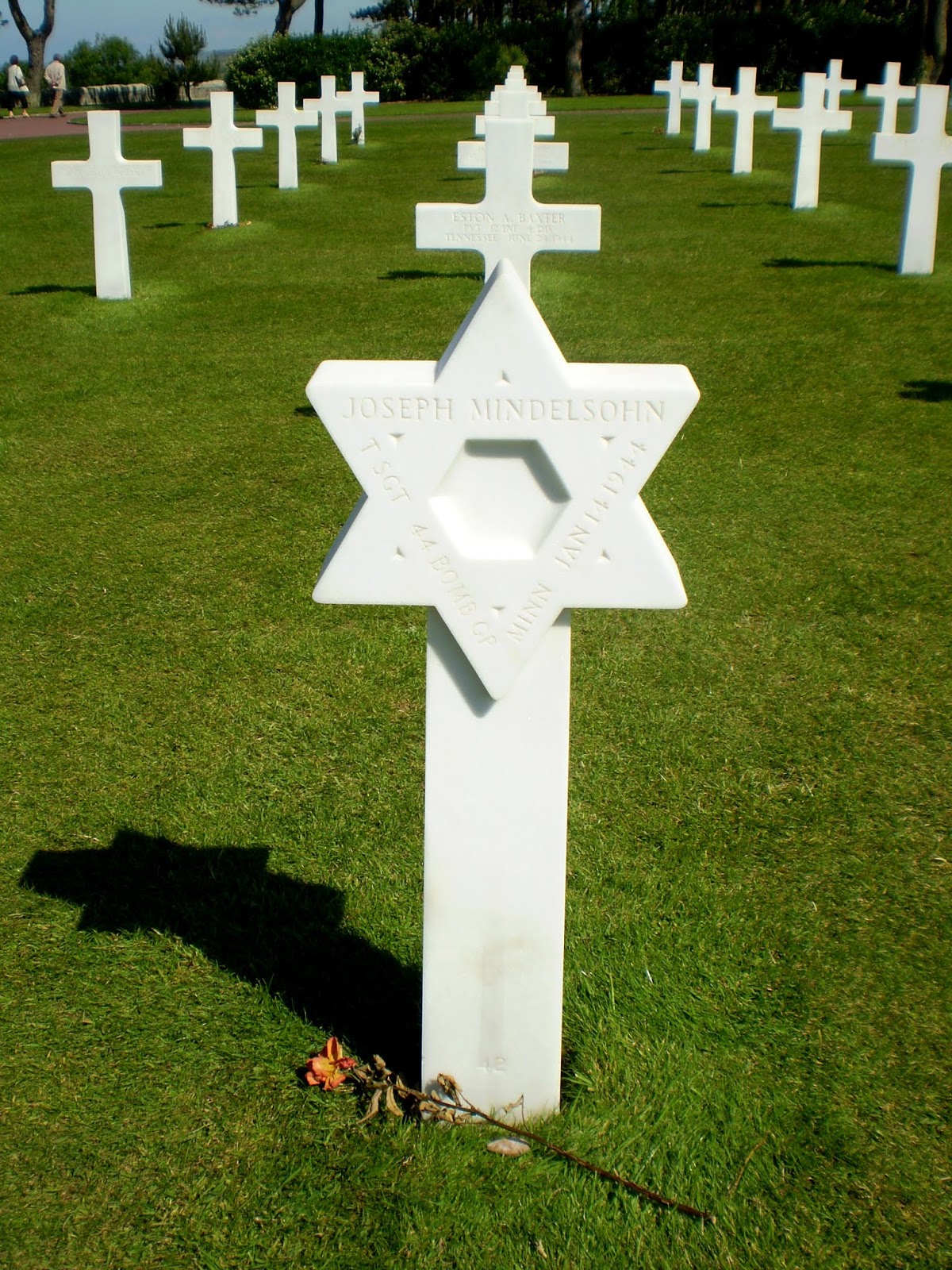
From there we moved on to the American Cemetery. This is truly hallowed ground, and it is impossible not to be moved by the elegant symmetry and simplicity of this final resting place for so many American soldiers.

I was particularly touched by flowers, left behind. Long past their peak, they remain, memorials and testimonials to a given soldier from -- who knows? A family member? A friend? A comrade in arms?

The cemetery is set on a high bluff overlooking Omaha Beach. I'm not sure you can tell from the photo just how far and how high that bluff is, but to be arriving on a boat in wretched weather, knowing the enemy was waiting for you on that bluff had to be frightening indeed.

Think of running up sand dunes -- it isn't easy. Add full fighting gear. It must have been a daunting task.

Now there are steps going down to the beach. Lots of them. Many of the pilgrims to the cemetery went down, as did I. Simply touching the sand, feeling that ground that had touched the feet of soldiers 65 years ago, was a sobering and moving experience.

And for some reason, the only family having a picnic here had a young girl in the family, who delighted in the broad expanse of beach. To me, she represented the purity, the future. After all, isn't it family we fight for most of all?

After leaving Omaha Beach and a stop at a German stronghold, we passed by this old church, named (as so many churches are in France) "Notre Dame."

It had been damaged in the war, and soldiers restored it.

I was rather capitvated by its stone work...

...and the heavy wooden door.

Then it was off to the beach at Arromanches, where some old German boat hulls, rusted and covered with algae, still rest in the waters at the shoreline.

One could easily visualize the soldiers in combat in these treacherous waters.

Our dinner destination was the town of Honfleur, about two hours away, perhaps. It's a port town, with LeHarve on the other side.

We expected it to be the quietly bustling town Jerry remembered. But they were in the middle of a music festival and it was more than a bit manic!

Finally, after 11 p.m., we found an outdoor restaurant on the water.

A look at the menu yielded promising options!

And of course, I had to sample the escargot! I'd been dying to try snails since long before my trip began, inspired by a commentary in Peter Mayle's book "French Lessons."

And oh, he was so very right! Succulent, delicious. Garlic and herbs with that bit of snail. I'd do it again in a heartbeat!

Things I Learned Today:

Snails. Yum.

The writing "s/" means "sur" or "on the" -- "Sur La Mer" might be written s/Mer. Lots of the towns here were on the sea.

There are several women (nurses) buried in the American Cemetery.

I really never expected to be so moved as I was by a place such as this.

The best raspberries I've ever eaten were found at a foire en route to Normandy. I wish I had more!

Popular Posts