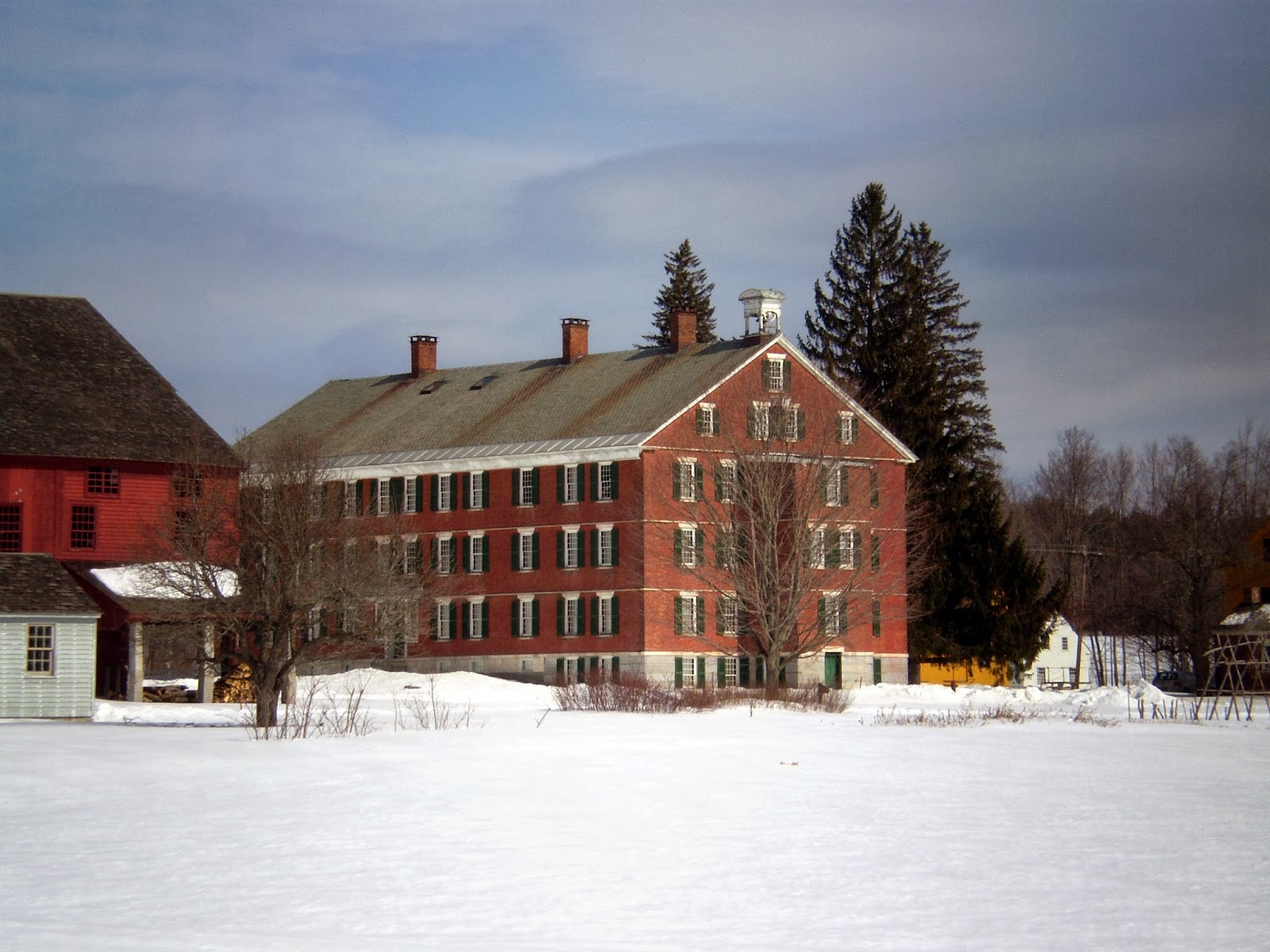
Before the snow melts, I thought I'd finish up my visit to Hancock Shaker Village in Pittsfield, Massachusetts. I had been there once, more than 30 years ago. But the Shakers are a subject that has long fascinated me, ever since seeing Ken Burns' early film The Shakers: Hands to Work, Hearts to God. There was a corresponding book that made it into my collection as much for the beautiful photos as for the content. I have always admired their simple but beautifully made designs.
So, when we visited Pittsfield last month, Hancock was high on my list of attractions to see. The trouble was, in the winter it is open only by appointment and our schedule wasn't tight enough to be able to schedule in advance. So I needed to be content with the exterior.
Fortunately, I have a few photos of interiors from a previous visit, although the quality isn't so great as I was shooting through the glass frames.
When you drive into the village the first thing you notice is that it isn't large -- a cluster of several buildings, spread apart on the land.
The Round Stone Barn is considered the centerpiece of the village. It
was built in 1826.
I recall from my earlier visit that there was also
a grain producing area within the barn, no doubt stored in the silos in at the far rights of the photo below.
Shakers are a religious order -- their members believe in pacifism, communal living and celibacy (which may account for the limited number of Shakers, none of whom live at Hancock. They were noted for their singing and exuberant dancing and that's how the name "Shakers" stuck.
As a group, Shakers are particularly noted for their craftsmanship including their architecture and furniture, which has clean, simple lines and is always well made. They were also noted for their architecture.
The Shakers came to Hancock in the late 1780s and peaked in the mid-19th century with more than 300 living on the 3,000 acre site. They lived in communal dwellings and were successful farmers.
The Shakers named their area the City of Peace and it clearly was a peaceful spot on the day we visited with nary a soul in sight. They channeled their energies into such indistries as crafts, basket and broom making, metal and woodworking, and marketed their items as a key source of income.
In 1960, the Shakers, unable to continue their village and industry, sold what property hadn't already been sold to a local organization to continue as a living history museum.
You'll find that buildings are plain and simple in design. But the use of color sets them apart -- especially on a snowy day when they are nestled into a world of white.
Take a look inside this window and you'll notice the detail on the door.
On my previous visit I was able to go inside. This is the doctor's quarters...
My favorite photo was this one -- the brooms for which the group was so famous hanging beside a door, the sun streaming through. (Again, shot through glass.)
I wonder what this little one was for.
These days the Shaker site has gone solar.
I suspect that's a good thing -- I wouldn't have wanted to be inside any of these buildings during this cold winter without it!
The condensation forming on the windows, the icicles, the snow. Yes, very cold.
But perhaps they just danced the cold away!