Showing posts with label Paris Museums. Show all posts

Tuesday, November 13, 2018

Paris: Much Ado about Mucha (and rightfully so!)

On every trip a little rain must fall. Ours fell on a Sunday.


Our plan had been to take off after breakfast for some vide greniers, then visit Rue Mouffetard to catch the street dancing.


We'd wrap it up with a stop at Musee Luxembourg for a visit to the exhibit on artist Alphonse Mucha.


Rain cut the antique sales short -- many had covered up their exhibits by the time we arrived. And we didn't expect the dancers to be out, so we headed to the museum. It was packed.


I'd long wanted to see this exhibit and I thought I might be bitterly disappointed when you could barely move, much less see the art.


But the crowd evened out as we moved along and the end result was fascinating. You are probably familiar with the artist's work, particularly some of his posters for Sarah Bernhardt (I had needlepointed one of these long ago, perhaps the start of my interest in Mucha!).


He was also a leader in the Art Nouveau movement and much of his work was included in advertising on tins and packaging. You could find his work on everything from cookie tins...


...to champagne bottles.


What I didn't realize was that the Czech native returned to Czechoslovakia when he was 43 and created a series of canvases that depicted the history of the Slavic people.


The details on these paintings are remarkable and markedly different from the more art nouveau style of his theatrical and advertising work.


A deeply religious man, he was also quite musical but longed to study art. Although he was rejected from Prague's Academy of Fine Arts, he became an apprentice scenery painter for the theatre in Vienna and also became attracted to photography. He later went into portraiture and decorative art and began to receive some commission work, which brought him travel opportunities and expanded his style as an artist. Ultimately he landed in Paris and began a career in illustration. He expanded his interest in photography and was able to use his photos as inspiration for his art. Soon he was illustrating books as well.


But it was his work for Sarah Bernhardt that brought him great attention. She commissioned him to do a poster for her play, but it wasn't the first time he had painted her.


Earlier he had done illustrations for one of her performances.


The poster he did this time was ornate but in pastel colors, different from other posters of the day and it caused a great sensation. Mucha was given a contract to produce more posters of Bernhardt and he became well known. He also designed sets and costumes for her.


The posters were so popular he became in great demand for advertising posters and packaging. He then launched a series of decorating panels.


His work appeared at the 1900 Paris Universal Exposition and then began designing elaborate pieces of jewelry.


His collaboration with jeweler Georges Fouquet brought him great acclaim and Fouquet asked him to design the interior of his new shop, which the artist did with elaborate style in the Art Nouveau manner. He later ventured to America where he continued to meet with great success.


Mucha's love for his native Czechoslovakia continued. But Hitler and the Nazis were coming into power and when they took Prague, Mucha -- a nationalist -- was a prime target. Arrested, he was interrogated for several days and then released, dying four months later  of pneumonia.


Despite being known for his Art Nouveau work, it was his Slav Epic paintings that he viewed as his most significant work. His style has since inspired countless other artists.


I don't know if this exhibit will ever tour, but if it does, I cannot recommend it highly enough. It was not only visually stunning but fascinating to learn about the life of this remarkable and gifted man.

Tuesday, November 6, 2018

Paris: Around the City!

Saturday morning was bright and beautiful and a terrific way to start the day was with a visit to the Orangerie, the lovely art museum adjacent to the more contemporary Jeu de Paume. where one can step into Monet's canvases.


Well, not literally. But you can step awfully close!


If Jeu de Palme (which we didn't have time to visit) sounds familiar it may be because during World War II, the Nazi's used it to store paintings looted from wealthy Jewish families and dealers, a story told most recently in the film "The Monuments Men."


After the war it housed many paintings which later went to Musee d'Orsay and today it is the home of paintings by Renoir, Matisse, Cezanne, Utrillo, Picasso and Modigliani.


I wanted to see the Monets. He had donated them to the government as a monument to the concluson of World War I and they were installed at the Orangerie at the suggestion of Georges Clemenceau. The canvas panels are enormous and take up two rooms in the museum with its curved walls and natural light giving a depth and dimension to his work that a flatter surface might lose.


Favorites of the painter, he kept them until his death in 1926, after which they were installed in the museum. One of the panels was damaged during World War II but immediately restored.


For Rick it was all about the Modiglianis, an artist we both enjoyed ever since seeing the film about his life with Andy Garcia one day when we were searching free movies on demand!


I love Modigliani, too. There is something about the flat simplicity that I really appreciate. As I look at some of the paintings, especially the long-necked women, I am often reminded of the work of contemporary artist Kelly Rae Roberts and wonder if she pulled a bit of inspiration from Modigliani's work.


I was especially thrilled to see many pieces by Maurice Utrillo, whose cold Montmartre landscapes speak to me.


Utrillo had a pretty bumpy life. He was the son of artist Suzanne Valadon, who also modeled and was a contemporary of Toulouse Lautrec, Degas and others of the period. Valadon encouraged her son to paint, partly to remedy his alcoholism, which appeared fairly early in his life.


He was periodically in mental institutions and experienced numerous detox periods during his life but painting did indeed help him to overcome the struggles of daily life.


Most of the paintings in the Orangerie were from his White Period.


Utrillo signed his name in different ways -- Maurice Utrillo...


Or on occasion, adding a "V" after his signature, for Valadon.


and sometimes just M. Utrillo, other times including a date. This variation can make it tricky for authentication!


As you might expect, Rick  liked this one...


...and this.


I loved the Rousseau.


And of course, the Renoirs...


...Matisse...


...and more Monet!


But there was more art in store that day! Because after a luncheon reunion it was time for Sennelier. More on that next time!

Monday, November 5, 2018

Paris: Passion and Money -- What a Combo!

When you have a grand passion -- and enough money -- you can do some pretty remarkable things. Edouard Andre and his artist wife, Nelie Jacquemart, had both and they built their home to display their extensive art collection.


The result was a gift to the country of Musee Jacquemart-Andre, located on Boulevard Haussman. Edouard had married the artist who a decade before painted his portrait and together they traveled in search of masterpieces to fill their Parisian home.


The couple's home was given to the Institut de France as a museum following Nelie's death, filled with their personal collection of remarkable paintings and antiques. The ceilings were works of art in themselves.


And the murals decorating the walls were by noted artists. I'm thinking Titian or Tinteretto or some "T" guy, but I may be wrong on that (to be honest, we saw so much art that after awhile it became blurry!


Just entering the main room is a bit awe-inspiring with its gold leaf.


This is part of the State Apartments, designed to host their formal receptions. Pretty fancy! And quite the selection of tapestries!


Rick was fond of the music room. There is a balcony for the musicians all around the top of it. And silk wallpaper and paintings.


Same room, looking down from the musician's gallery.


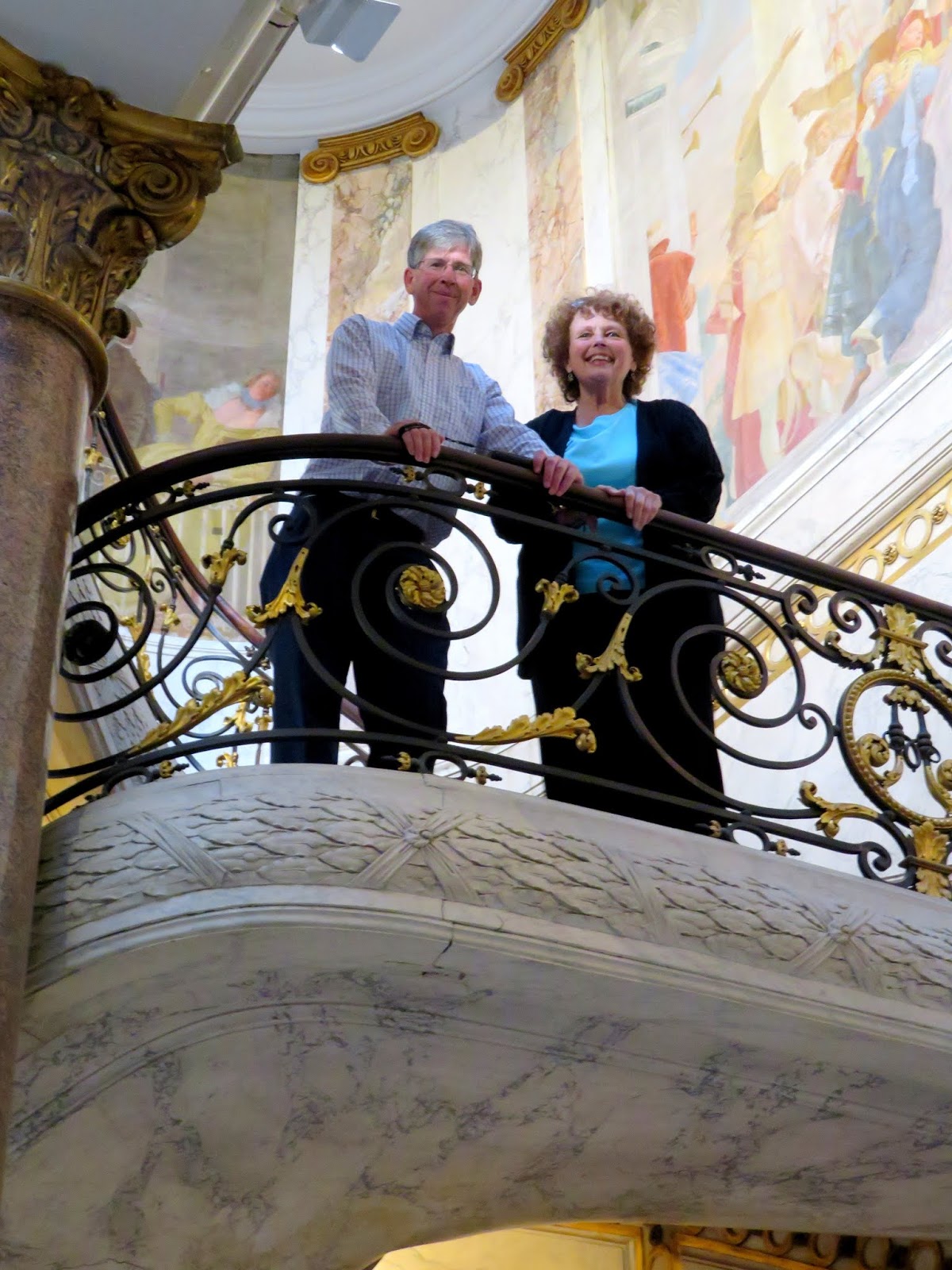
My favorite area was the Winter Garden, which is quite like a conservatory with a spiral staircase leading to a gallery above.


I couldn't help but notice this woman.


She was sketching one of the sculptures in the Winter Garden, seemingly oblivious to the crowds around her.


 Here we are overlooking the Winter Garden.


There is quite a sculpture gallery -- I particularly liked the Della Robbia piece, but it also included works by Donatello and others.


Works on religious these were featured in the Florentine Gallery, along with works by Botticelli, among others. The couple also loved Venetian artists and many of their works are featured here as well.


Finally, we got to see the couple's private apartments, which while somewhat more intimate were still a little over the top! At least for me!


Also featured during our visit was an exhibition of work by Caravagio.


I can't say it wowed me, because for the most part, much it was rather gruesome and I didn't take pix of those. I rather liked this one, though.


But you have to admire his remarkable technique.


I certainly admire the elegance of the Jacquemart-Andre family ...


...and beautiful art collected lovingly and displayed well is indeed well worth seeing.


This was the only room (apart from the Winter Garden) that resonated with me personally. Could I live in this space?


Not on a bet.


Fortunately, not a choice I'll have to make! But it's lovely to visit!


After all that, it was time for crepes!


After all, this sightseeing stuff gets tiring!

Popular Posts