Showing posts with label Kensington Palace. Show all posts

Wednesday, January 9, 2019

London: The Diana Dresses

Yeah, OK. I'll admit it. I used to have several files of clippings about Diana and Charles, beginning with their courtship and through much of their marriage. Actually, I think I still do in a file cabinet in my basement!


And I have a fairly good library on the British royals. But until today's Duchesses, no one had the style that the Princess of Wales had.


So, when we went to Kensington Palace, I was delighted to see the Princess Diana gown and outfit exhibit. (I know. Guys don't get it.)


There were many I remembered from those videos and press clips.


And some I'd never seen.


The museum did a nice job of matching up a photo of Diana wearing the outfit to the outfit itself.


(Rick and I were a little shocked that she wore this to go shopping in Bond Street!) We don't dress that well when we shop.


This was worn at the Christie's gala when many of her gowns were auctioned off.


And here it is.


The Travolta dance dress was on display...


...as was this sweet outfit she wore as a "going away" outfit for her honeymoon...


...and this one worn during an interview at Balmoral when they returned.


I liked the sketches by some of the designers.


This wasn't on display, but I remember the dress.


Neither was this, but I can imagine it on her.


They did a beautiful job with the exhibit, including videos and photos.


And I had to admire every designer who had the privilege for designing for such a terrific model. There were outfits for all occasions, from grand gowns...


...to "work-a-day" suits.


And although many of the gowns were not displayed chronologically (unfortunately) it was still interesting to see how Diana's style changed and evolved over time. From this...


...to this.


All in all, a delightful way to spend a drizzly day in London!


(And above, the "wallpaper" leading down the hall to the exhibit. And yes, available in various forms in the gift shop. And no, I didn't buy it!)

Sharing this week with:  Pink Saturday    /    Let's Add Sprinkles     /     Timeless Thursdays    

Monday, January 7, 2019

London: A Visit to Kensington Palace

Kensington Palace. I remember seeing it with my mom when we traveled here in 1973. I had recently graduated from college and while we didn't know it, she was ill with her cancer during the trip. She was my Invisible Traveling Companion on my trip with Rick. (I wrote about the experience of having an invisible companion HERE at Modern Creative Life, so I hope you'll stop by and check it out!)

We know Kensington Palace as the home of the modern young royals. Diana raised her boys there, William and Harry both currently live at Kensington Palace in the apartments along with many other royals. And many know it was the birthplace of Victoria, and indeed, the place where she was informed she was now Queen.


Not everyone realizes it goes back much farther in history. In 1689, William and Mary purchased a smaller mansion and asked Sir Christopher Wren to oversee an expansion. He added onto the mansion, turning it into a palace with apartments for the King and Queen. Their time there was short; Mary died of small pox in 1694 and William, following a horseback accident in 1702.


Queen Anne was the next to live there and continue the renovations. (This is the Queen Anne of the film, "The Favourite," much of which is set in Kensington Palace and not filmed there!) The King Georges I and II were the last to live there, with it turning into a home for minor royals after. Not the least of these was Princess Alexandrina Victoria, George IV's niece, who became known as Queen Victoria.


When you enter, you have the option to go to the Queen Victoria section or to the older sections first. We chose Victoria because -- well, she's Victoria, the woman who was never supposed to be Queen and until the recent milestone of Queen Elizabeth II's reign, the longest reigning English monarch.

You walk up the staircase which overlooks the foyer. It was here that Victoria is said to have first seen Prince Albert, who she would later marry.


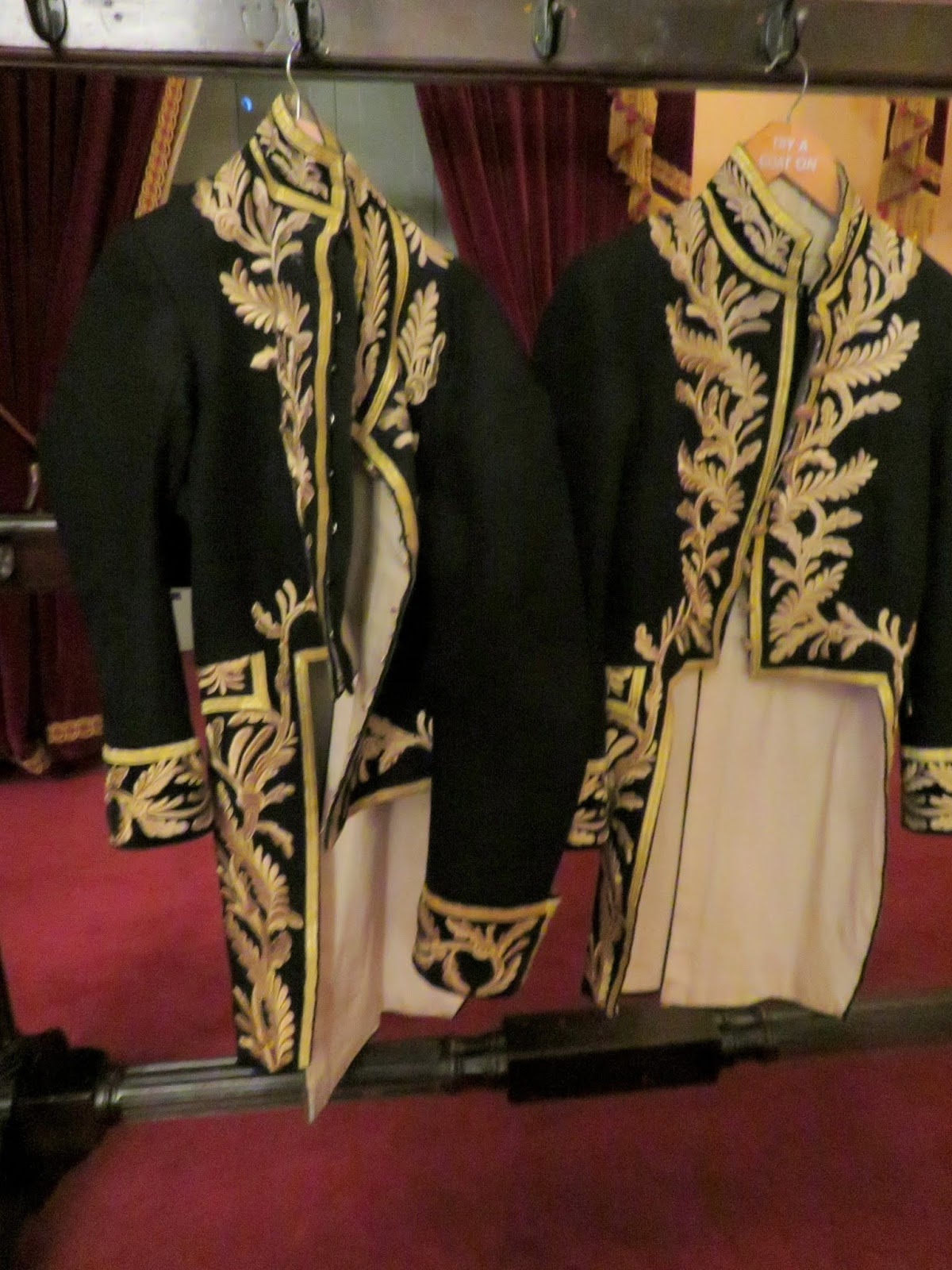
In this section you will first enter the room where she met with her ministers the morning she awakened and was told she was queen. They were all there -- Lord Melbourne, Lord Wellington, and even Earl Grey, for whom the tea is named. The names of those who gathered there are stenciled on the wall. It also had a few costumes, which I think one could try on. (We didn't!)


One of Victoria's gowns is on display. I liked how they did it with the mirrors surrounding it so one could see front and back.


I also loved this lovely portrait by Franz Xaver Winterhalter, a German artist who often painted the Royal Family. This is a private portrait, commissioned and posed for by Victoria as a surprise for Albert's 24th birthday. She wrote in her journal: 'He thought it so like, & so beautifully painted. I felt so happy & proud to have found something that gave him so much pleasure.' In a later journal writing she referred to it as 'my darling Albert's favourite picture' (Journal, 2 January, 1873). (Source: Royal Collection Trust)


There were also portraits of many of her family members, including -- in the nursery (where I took precious few photos or else they were so bad I deleted them) a family "tree" of sorts listing all her children. Here is one of her daughter Vicky and her husband, Fritz, father of Kaiser Wilhelm II.


(I'm disappointed I didn't photograph more in the nursery. It was her most personal room, the one in which she spent the most time growing up, practically imprisoned by her mother and her mother's advisors, presumably for protection and quite possibly from influences.) It included her dolls and dollhouse, other toys and a cradle. In a way, the most personal of the rooms.

A chapel-like room focused on Prince Albert and included a lovely bust of the prince as well as video. There was also an area in which several of her tiaras were on display.


We were told they were indeed "the real thing"  apart from one earring in the set below. The necklace, earrings and brooch were designed in 1843 by Prince Albert for Victoria, and she wore it to a banquet at Trinity College, Cambridge, to celebrate Albert's appointment as chancellor. She also wore it to her son's christening, paired with lace from her wedding dress. In 1845, Albert worked with jeweler Joseph Kitching to design the tiara. Delighted with her gift Victoria wrote in her diary of her husband's "wonderful taste."


Here's a better look.


They were all lovely.


I should mention here we were touring independently but periodically the palace has what they call "explainers" who do a 15 minute or so talk about the area. We had toured much of the Victoria section before we saw the "explainer." It was well worth returning for, as he truly amplified the context of her reign, history and impact -- especially in saving the palace itself. Plus, he was loads of fun with a great sense of humor. Here's our "explainer" in that first room we visited.


Then it was on to the Kings and Queens apartments. These were exceedingly opulent. Think gold, paintings, silk on the walls.


As one might expect, no expense was spared on the beautifully painted and gilded ceilings.


Kind of a jaw-dropper.


One can imagine many gatherings, some of which the Explainers described vividly.


Take a look at this gown.


Then consider hitting the bathroom in this. Well, first of all, there wasn't a bathroom. So a page would go about to the ladies with a chamber pot, "enter" through the back of the gown and hold the pot so the woman could relieve herself (presumably while sipping champagne!)


I was intrigued with the interesting looking game tables.


I wonder how one played these?!


The Queen's Bedroom was quite elegant.


But my favorite was the Cupola Room.


The room was designed by renowned architect, landscape designer and Palladium-style aficianado William Kent. It was part of the remodel of the King's State apartments in the 1720s and rather than using stone for the columns, he saved money by using timber and plaster.


King George II and Queen Caroline were patrons of George Frederick Handel, who dedicated compositions to them and served as their children's music teacher. One can imagine elegantly dressed guests dancing the minuet and country dances in the Cupola room. (In the photo above you can see the shadows of dancers of the past through the video projections.) Meanwhile the Queen, noted for her love of gambling, took on guests in the Drawing Room.


At the center of the room is the Temple of the Four Grand Monarchies, a clock that represents the Assyrian, Persian, Grecian and Roman dynasties and that originally played music by Handel, Arcangel Corelli and Francesco Geminiani.


 There were, of course, numerous artifacts, paintings and pieces of decorative art. I have to say that although this seems simple by the more ornate standards of most of the rooms, I really did love this part.


I've gone on long enough. Lest you should think our visit to Kensington Palace only featured things from several centuries past, the next post till take you on a more recent recollection.


See you soon!

Sharing with:  Let's Keep In Touch    /   Pink Saturday    /     Timeless Thursdays    

Popular Posts