Thursday, January 24, 2019

London: Canada House and Group of Seven Guitars

Time for a little more art -- and this is of a completely different nature! As you probably know if you are a regular reader or been following these posts, Rick is a passionate classical guitar fan. And both he and I are very fond of our neighbors to the north in Canada, a mere two hours to the border. After my Pollock's Toy Museum visit and our St. James concert, we knew we would be enjoying a play in the West End that evening so we walked toward Trafalgar Square, planning to find someplace for dinner a bit later. And located in Trafalgar is Canada House, where they were hosting a guitar exhibition.


Canada House is the home of the High Commission of Canada to the United Kingdom and hosts consular facilities for Canadians. It is a place where they can renew passports, apply for emergency assistance and other services. The building is used for special events, conferences and hosts Canadian-related exhibitions, such as this one, related to the Group of Seven.

The original Group of Seven were Canadian visual artists (painters) from the first recognized art movement formed in the country in the 1920s. They all had  a strong connection with nature and a desire to create a distinctive Canadian art from with that philosophy. (There are probably better sources for this but an easy read on the Group of Seven is here at Wikipedia with links to individual artists and their works.) AND, to see some of their works, Blogger William just posted on the Group of Seven's art in Ontario's National Gallery, so please check him out HERE.


Seven master luthiers from Canada were commissioned to create an exhibition of unique and beautifully designed guitars, as their materials describe, "forging a collective legacy that has shaped the global guitar-making industry. They recognized the same creative spirit and camaraderie of the Group of Seven artists with their love for their country and passion for mastering their materials. Each luthier chose a Group of Seven artist as their inspiration and crafted a guitar based on their work, life, words or philosophy, as interpreted by the luthier.

We greatly enjoyed the explanatory film. This isn't it, but it gives a great overview of the original Group of Seven and the Guitar Project.


George Gray's guitar was inspired by the skies of Frank Johnston, particularly the artist's aerial painting.  Gray selected cherry wood for his instrument from a cherry tree growing on Johnston's former property in Wyebridge, Ontario.  For the center rosette, Gray used a piece of granite from the Canadian Shield outcrops in Parry Sound, Ontario.


Luthier Tony Duggan-Smith created his guitar based on the art of Arthur Lismer. Lismer, a founding member of the Group of Seven, spent time at Nova Scotia School of Art and Design as a professor; Duggan-Smith was a student there some years later.


The spoon at the head of Duggan-Smith's guitar is a relic of the luthier's days at the school, but he feels his guitar is more a connection of the pair's creative connection and East Coast beginnings.


David Wren found inspiration in the work of Franklin Carmichael. Wren said he felt at liberty to take risks and in doing so interpreted some of Carmichael's sketches and prints using a technique called pyrography, a first for the luthier.  


His research revealed personal connections to the artist and incorporated that feeling into his design. "He was a meat-and-potatoes kind of guy and I like that," Wren said, remaining committed to the meat-and-potatoes of his own craft -- Building a guitar that sounds great.


Luthier Grit Laskin's design is based on an interpretation of F.H. Varley. Both were attracted to portraiture. Laskin used exquisite inlay work and color on his piece.

 
He included a self-portrait on the neck of his guitar where he holds a drawing by Varley titled "Constance."


He also rendered Varley's own words in reaction to World War I on the instrument, including, around the sound hold, "For What?" and "oh, if it were only possible for you people to know what it was like" along the soundboard, a look back at the tradition of protest statements on soundboards, such as those of Woody Guthrie.


Jean Larrivee was inspired by A.Y. Jackson. A stack of Jackson's landscapes are represented through more than two thousand pieces of inlaid wood within the interior of the guitar and can be glimpsed only through the sound hole.


Larrivee's wife Wendy and their son Matthew also contributed to the creative process and explains the choice to keep the grandest part of the aesthetic design to the interior of the instrument as a reflection of how a work of art is an expression of what the artist feels inside and that the interiority of the artist is one of the most compelling aspects expressed in a work of art. "Growing up in Ontario I really felt that the works of the Group had impacted heavily on how I and generations of Canadians viewed our landscape, that I had somehow internalized these images and they had become part of the world as I knew it," she says. The red maple leaf on the fret board inlay was inspired by Jackson's "The Red Maple."


Linda Manzer's guitar is based on work by Lawren Harris and her design was in imagination of what Harris might create if he built guitars. His paintings and Manzer's guitar include body form and color. She drew particularly on two of his works, "Mt. Lefroy"and "Icebergs, Davis Strait," along with an oil sketch called "In the Ward." She was also inspired by Harris' letters to Emily Carr, urging her to be brave and explore. Manzer painted her guitar and "sculpted" it as well. 


The guitar looks like an archtop by is internally a flat-top guitar, a construction that lends strength to withstand the pressure of all the strings and allowed her to carve curves depicted by Harris in "Mt. Lefroy."


Sergei de Jonge discovered that his "artist," J.E. H. MacDonald, painted close to the luthier's home and shop in the Gatineau area. De Jonge's guitar is made from wood sourced in the various places that the artist sought to paint and the only handmade guitar made from birch. 


Harris felt MacDonald was the "wise man" of the Group of Seven and De Jonge has been described by his fellow luthiers as "the quiet sage amongst their groups." Both De Jonge and MacDonald have had teaching careers in their disciplines.


So there you have it. If you'd like more on any of these luthiers, put their name into the youtube search box (ex. Linda Manzer Group of Seven) and you'll see some terrific videos that includes their music and descriptions of their creative processes as they build the guitars featured in the exhibit.

Sharing with:   Best of the Weekend     /    Pink Saturday    /   Keep In Touch   

Tuesday, January 22, 2019

London: That's Entertainment

Any big city has more than monuments and parks and London, of course, is no exception. So I thought I'd venture off into a few of our cultural endeavours!


You saw that we went to the Philharmonic and Rick had recitals at St. James. We also saw a guitar concert with Jenny and T earlier in our London time. But I had theatre on my mind. And actually, our first theatre venture bombed. Bad planning!


After our Sunday at the St. Paul's and the Tate and after a break, we thought we'd go down to the West End and catch a dinner and a play. I wanted to see Eileen Atkins ("The Crown" and "Doc Martin") and Jonathan Pryce (from the original "Miss Saigon" and "Evita" film) in "The Height of the Storm," a contemporary drama by a French playwright. When we got to the West End the theatre was dark and street guys were laying in the doorways. We decided we were early and went to find a restaurant.


We happened upon Giovanni's, an Italian restaurant on Bow Street. Since it was only a couple of hours before show time, we were curious as to why it was practically empty but it looked lovely so in we went.


And it was. A fine dinner, a rather engaging duo of (probably) owner and waiter. The owner had been there forever and photos of famous diners (well, at least photos of famous people) covered the walls.


The food was good (but beware of upcharging!).


Then back to the theatre, still closed. And then we realized, we should have checked to see if there was even anything going on!


So, we walked around a bit and while we didn't gamble there, checked out the Hippodrome, now a casino. It had great bathrooms.


This very famous spot was, in the day, the variety palace where people like Charlie Chaplin and Archie Leach (Cary Grant) performed, along with a ten-year-old Julie Andrews and Houdini (not all at the same time!). It was worth a wander.


(The next night we returned and did indeed see the show -- and it was well worth the trip back.)


I am a great fan of theatre architecture and the Wyndham, where "Height of the Storm" played, is quite a beautiful theatre. There really isn't a bad seat because it's not overly large. (A little cramped, perhaps, but not a bad view.)


And I appreciated the detail in the set design as well. It was quite a remarkable and thought provoking play, one which Rick and I have discussed more than once since our return and several months later.


One of the things I wanted to see in London was Stephen Sondheim's "Company." I love Sondheim and this time Bobby, the male lead was Bobbie, a female and the show, originally set in the 1970s, was updated with Sondheim's support.


My Canadian friend Suzanne and her husband Jim were in London then too and we saw the show together. It was a bit hairy getting to the theatre. Rick and I had gone separate ways late in the afternoon and I told him the wrong tube line to take; then I took a couple of wrong turns out of the tube myself and got there just in the nick of time!


But again, worth every penny. I hope they bring it to Broadway.


(Or at least do a CD. Rosalie Craig was a terrific singer and Patti LuPone just killed "The Ladies Who Lunch.")


And no, I didn't see this. But isn't it a great theatre facade?


I could have hit the theatre every night but I was with Rick who also wanted to hear some classical music. He did catch a second recital at St. James later in the week, this time piano/oboe. He enjoyed chatting with the musicians after.


And we also enjoyed quite a wonderful evening at St. Martin's in the Fields, where they offer classical chamber concerts.


It was a nice way to see this beautiful church, one that seems to extend into its community with great outreach.


We caught a concert featuring some of the more well known composers -- the A List -- and Rick was worried that the music might be all the old chestnuts you associate with these guys, but we were pleasantly surprised.


And, the atmosphere was quite lovely and the sound very good indeed.


Theatre tickets can be pretty pricey, but the concert tickets were surprisingly reasonable. And of course, some of the best entertainment is free!


(Although a coin or two in the collection box is always welcome!)


Travel Tips

  • If you really want to see something, get tickets in advance. We did have our "Company" tickets in advance (and didn't realize it was opening night! It was fun reading reviews, knowing critics saw the same performance we did!) You can order online from home.
  • Or, pick up tickets at the box office if you think you can get your show. You'll save in ticketing fees.
  • Or, go to the Leicester Square half off booth to get a good deal. (There are imitations; beware!)
  • Don't make our mistake and end up at the theatre on a "dark" night!
  • Again, don't forget to check churches for recitals and concerts or even a service or Evensong for more classical music.
  • Dining Out in the West End -- Plan ahead or allow plenty of time if you are seeing a show. And don't overlook the obscure. You might have fun at a fish and chips vendor.  And beware of upcharging. At Giovanni's, they asked us if we would like bread, which is quite common in the states as complimentary. When we got the bill, we found out it was not at all complimentary!
  • One of our favorite places was "The Crypt" located in the basement of St. Martin's in the Fields. You have limited choices -- whatever is being served in the cafeteria line -- but it's good food, wine is available and the price is reasonable.

And besides, the atmosphere is pretty neat and you can't beat the location, right across from Trafalgar Square and the National Gallery. Speaking of which, it's time to get back into some art in the Trafalgar Square area!

Monday, January 21, 2019

London: Time for Toys

After our St. Paul's/Tate Sunday, I needed a lighter day. Yeah, those feet.

Before we move on to today's post about Pollock's Toy Museum (a real treat!), I wanted to clarify something that I may have badly stated last time when I spoke about that first experience in the wheelchair -- here's the quote:  "And then I really broke because it felt so embarrassing to know you had to be pushed through a museum. I mean, going to museums is what I DO." And I feel I should clarify this, for I may have offended some with that word 'embarrassing.'


I know or have known loads of people rely on the chair to get them just about anywhere. My dad did in later years as does another extended family member whom I admire more than just about any woman I've ever met. I've never viewed the wheelchair embarrassing for those who need them. And we may all need one at some point or permanently sooner or later. The wheelchair can open up the world to those who can't see it on their own two feet.


What I was embarrassed -- and probably a little angry -- about was the fact that I was broken and could not do what I usually do -- walk about and enjoy the art under my own steam. I was embarrassed and angry that my body had rebelled in a very painful way, so painful I had to rely on assistance when in my regular world I would be the one pushing someone else. Embarrassed that this happened in public. By the end of the trip, any self-consciousness I had on that zone had disappeared and in fact, I was as likely to say to Rick, "hey, can you please find the wheelchair" as I was to try to go it on two feet. That first time is tough, knowing your limitations are greater than you planned. But it was also a great blessing.


So, if I inadvertently offended, forgive me. If anything, it provided a greater empathy that I know will be useful in the future. Now...

Those of you who have read Jenny Woolf's travel blog know that she'll often feature some fascinating and off-the-grid places and I found out about this one from her. Pollock's Toy Museum in London doesn't always make the guidebook cut but it is well worth a visit if you love old toys.


And for me, it had another attraction -- the wonderful toy theatres, some of which are very old and all made by hand. (Jenny wrote about a recent toy theatre production of Aladdin right here and here and she has some terrific photos.)


So, while Rick went back to the guitar center, I took the tube to Pollock's, and when I rounded the corner, this is what I saw.


Now, isn't that the most charming building? Actually, it is two buildings, from the 17th and 18th centuries, combined.


And it's full of all the features old buildings like that have -- low ceilings and narrow, winding staircases. (In other words, not for those who can't climb.)


In brief, the museum, in London's Fitzrovia, was originally a shop and printers dating back to the 1850s. The collection is largely Victorian and displayed in six small rooms and on every available bit of wall space. Of special interest (especially to me) were the toy theatres. Benjamin Pollock hand printed, constructed and colored much of the toy theatre material housed in the museum today.
It came to it's current location in the late 1960s. 

Well, of course I bought my low-priced admission ticket and stepped inside to enjoy a time travel trip, back into the toys of the past. Come take a look!


You wind your way up the narrow staircase and into various rooms. Large cases protect much of the collection.


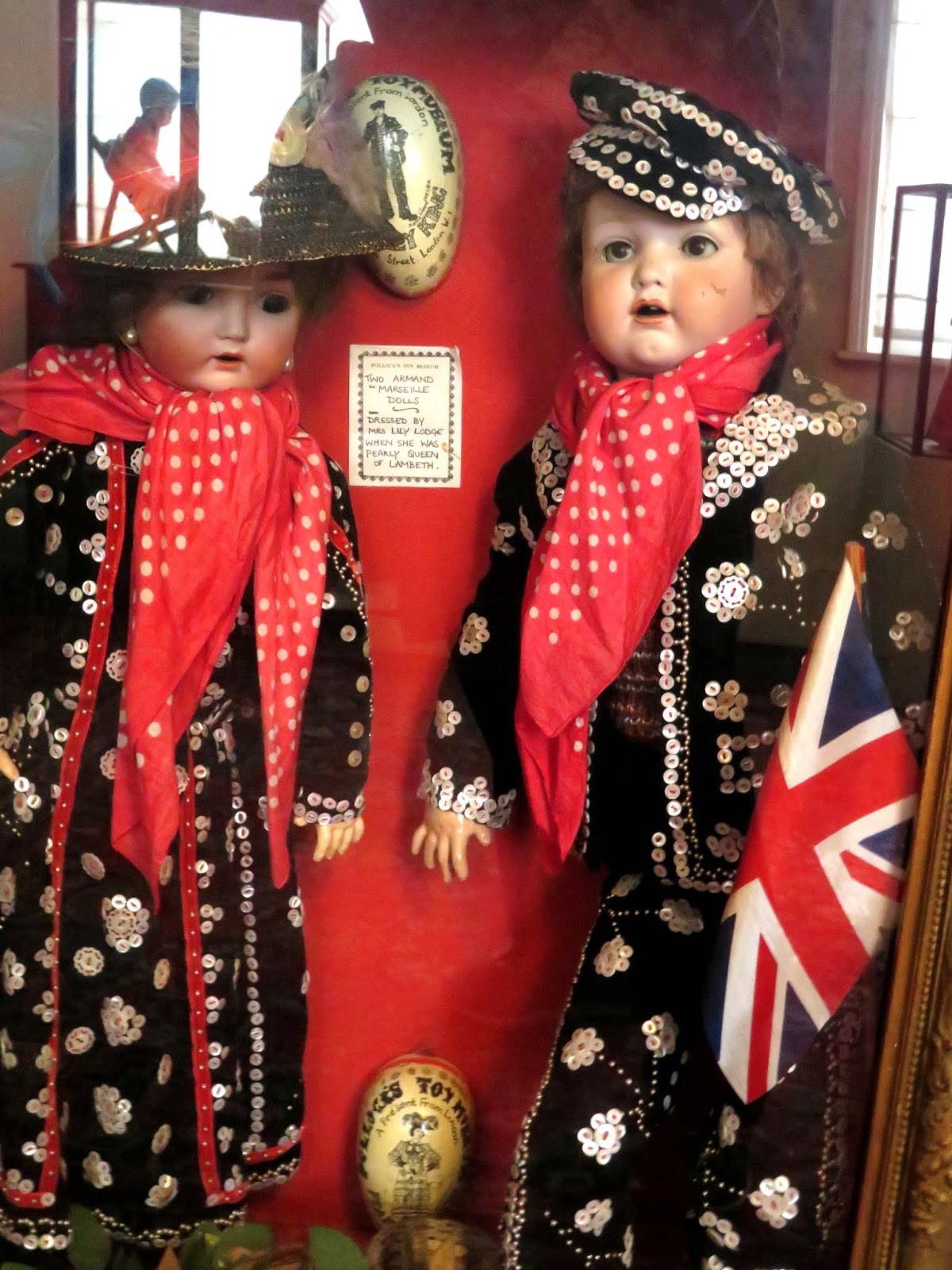
And what a collection it is! If you loved dolls, you have everything from the little baby doll...


...to elaborately dressed little girls...


...and fancy-dressed dolls.

 
This one was a little creepy.


Even Queen Alexandra was preserved in doll form!


Military toys dolls were not ignored.


Nor were dollhouses and miniatures.


This one was quite spectacular and it was just about impossible to get a halfway decent photo, much less a decent one!

Teddy Bears? We have a few...


...and a few more!


Blogger Elizabeth is a rocking horse fan.


These are for you!


This scene is supposedly of Mr. Pollock, creating one of the toy theatres.


There were board games and tiny animals, puzzles and puppets!


Of course Punch and Judy were included!


There were even toys I remembered and owned!


Every square inch was covered, ceiling to floor!


But my favorite part was the toy theatre section. The typical size of these was about two feet wide and maybe a little bit taller.


Benjamin Pollock created most, if not all, of these himself and they are elaborate representations of actual London theatre stages.


This is a bad photo because of the lighting but you can see there are several sections with grooves in the base.


These allow characters to slide in and out of a scene at different depths of field, adding to the perspective.


Can you imagine seeing a show in one of these? (Jenny did HERE)


The detail of the scenery painting was exquisite.


And you can only imagine the countless hours it took to not only engineer one of these but actually design, draw, create, cut out and assemble the various parts.


And of course the museum empties out into a fun gift shop where I found a few things from times past!


It was time to leave Pollock's and meet Rick back at St. James Church for another concert. Then we enjoyed lunch in the marketplace outside the church.


Wonderful crepes, made while you waited!


From there a short walk to the National Gallery and a special exhibit at the Canada House! Next time!

Sharing with:    Let's Add Sprinkles    /   Best of the Weekend   /     Pink Saturday   

Popular Posts