Showing posts with label churches. Show all posts

Sunday, January 26, 2025

This England: Road Trip: The Church in Burford

After a day perusing the intriguing collections and gardens at Snowshill Manor, we were ready to find our lodgings and have a good dinner. We headed off to Burford, a small town in Oxfordshire, and landed at the Royal Oak, a pub with lodgings above.

It wasn't our favorite hotel -- the rooms were cool and the dinner expensive. I wrote in my journal "adequate but not spectacular fish and chips."  Still, the lodging price was right and I would return. The room was comfy enough, but I think we were spoiled by The Bear. (Maybe when it was a little warmer out!)

Saturday, September 9, 2017

La Belle Quebec: Trois Eglises

While I'm not one to hit every church in site when I travel, I do love and appreciate the architecture and flavor of various churches, as well as their histories, so while I Quebec City, I checked out a few.


Notre-Dame-des-Victoires is a Roman Catholic church and it is located in Basse Ville (Lower Town) of Quebec City. The original church was started in 1687 on the first town square in the city and built on the site of Samuel de Champlain's original outpost. It was completed in 1723.


In the late 1600s it received the name Notre-Dame-de-la-Victoire because the English were forced to retreat, providing a victory for the French. The "s" was added at the end in 1711 when a British fleet was sunk during bad weather.


The church we see today was restored in 1816 when the original was destroyed in large part by a battle with the British that preceded the famed Battle of the Plains of Abraham in 1759.  It offers worship services and is quite a tourist site. In 1929 it was listed a National Historic Site of Canada.


I liked its clean simplicity, a minimum of the gold that so many churches seem to sport and the airy feel. Note the ship hanging from the rafters over the congregation.


It may be a myth or perhaps this is only in France but several years ago I learned that those in the fishing and shipping communities of Brittany in France often hung a boat over the congregation, a reminder of prayers for the safe return of the seafarers. In this case, it is a model of the ship Breze, commandeered by by Marquis de Tracy, a lieutenant governor in New France in the mid-`1600s.


Much of New France included those from Brittany and located on the shores of the St. Lawrence River, perhaps this is the reason the ship takes prime space.


The second church we visited was The Cathedral of the Holy Trinity, which is the home of the Anglican Diocese of Quebec and home to two parishes.


Founded in 1793, the building of a cathedral was a special project of the Diocese's first bishop.  The building took four years to build and was completed in 1804, the first Anglican cathedral built outside of the British Isles. It was designated a Historic Site in 1989.


The church was modeled after St. Martin in the Fields (London) and Marlebone Chapel in the Palladian Style and funded by King George III, who provided a folio Bible.


Alas, I have no photos of the remarkable Georgian silver exhibit that was there during our visit, or the bible but it was magnificent.


The church has a wide center and wide side aisles and magnificent stained glass at the altar. Surrounding the altar are the words to the Lord's Prayer, the Ten Commandments and the Apostle's Creed. Notably simple and elegant and design, there is a minimum of gold leaf, primarily on the arches.


The third church was the Cathedral-Basilica of Notre-Dame de Quebec. It is the seat of the Roman Catholic Archdiocese of Quebec, which is the oldest in the Americas north of Florida. It is also a National Historic Site and UNESCO World Heritage Site.


The church has been at this site since 1647, though it has been destroyed by fire twice, including the 1759 Siege of Quebec. The facade is Neo-classic, based on the church of Sainte-Genevieve (Paris).  The second fire was by a Canadian faction of the Ku Klux Klan. It serves as the burial site of several governors of France as well as Catholic bishops.


It's clear they brought out the big bucks for this one. There is oodles of gold. Way more than I like but certainly it is quite impressive. As with the other two churches, services are still held here.


There are some lovely details, beautiful arches...


...and a splendid Therese de Lisieuz. A friend shared this in the comments: "Mary doesn't ever hold a crucifix.And then I noticed the roses (so beautifully carved) and the inscription, "...tomber une pluie des roses."
 
 "Après ma mort, je ferai tomber une pluie de roses" / After I die, I will let fall a rain of roses.

This is Therese de Lisieux.  A/k/a  The Little Flower, or the Little Child of Jesus. An enfant terrible, but what a personality!  A French nun, she died at 24, I think, tuberculosis, after slaying everyone at the convent with her piety, her sweetness, her sunny disposition and frequent reminders of her close friendship with le Bon Dieu. 


We might have stuck around longer to explore a bit more but church was starting. Nonetheless, an impressive place to worship.


As for me, I have been lighting candles, metaphorical and otherwise, for those in Houston, Florida, Louisiana, Mexico and the Atlantic coast, as well as the islands ravaged by Harvey, Irma and potentially Jose. I send wishes to friends virtual and in-person who are recovering from the storms or soon will be.

Miss anything -- here are links to Day One (Arrival) / Our terrific B&B / Day Two, Morning / Day Two, Afternoon /  Day Three /

Tuesday, June 19, 2012

Sainte-Chapelle

If I had to advise someone on the "must see" church in Paris, it wouldn't be the enormous Notre Dame or St. Sulpice with its notable organ. It would be Sainte-Chapelle. So, after our visit to Montmartre, we were off to hear a concert!   

Thursday, May 31, 2012

Road Trip: Mont Saint Michel

After leaving St. James, we continued to head toward Mont Saint-Michel, an island and monastery located in the western corner of Normandy, close to the country's northwestern coast. This was the view from the car window.


Yes, as you might expect, our arrival was a rainy one, although the rain stopped and started, leaving a gloomy gray during its brief reprieves.


We parked and walked up to the massive island, which is reached (currently) by a causeway. It is largely surrounded by bleak waters -- and one wouldn't want to be caught on the wrong side of the island when the tide is in.


 Some of the visitors were better prepared for the rain than I was!


Mont Saint-Michel served as a point for holding fortifications, but since the eighth century it has been the seat of the monastery and a pilgrimage destination.


Legend has it that the Archangel Michael appeared to the bishop of Avranches in the 700s and told him to build a church on the small island. It became a strategic point in wartime as depicted in the Bayeux Tapestry, which tells of the 1066 Norman conquest of England. It is also considered a fine example of military architecture.


Over centuries Mont Saint-Michel has served as village, monastery and prison. Notably, Victor Hugo was one launched a campaign to restore the structure to national architectural treasure, resulting in the close of the prison in 1863 and eventually declaring it as a national historic monument.


The architecture is like that of no other monastery. Because the island mount is a pyramid, the medieval builders wound the buildings around the granite rock, with the abbey church at the top.


The original abbey church is clearly Romanesque in design and was built in the 11th century. Because of the weight of the structure, many underground chapels and crypts were built to support the structure.


In 1204 a fire damaged many of the buildings and when the abbey was rebuilit, it was in the "new" Gothic style. The refectory and cloister reflect this style.


The 15th century ramparts and fortifications were built to defend the site from the cannon -- a new weapon.


Now, 41 residents live on the island in apartments above shops, hotels and restaurants that one passes leading up to the abbey. 


We walked (and walked) and walked, through pathways...


...and up the cobbled steps to what I call a terrace -- I'm sure it has another name.


And, by the time we got there, the sky was a mix of gray to the sea and blue above the spire.


You see? Sun! You can't get shadow without it!


The view was pretty amazing and quite formidable -- imagine being a soldier approaching it from the sea -- or anywhere, for that matter.


One can't help but admire the builders who hauled the stone and built this massive structure, but as churches go, it isn't exactly warm and inviting.The lighting and floor of this chapel was the sole exception.


I found it cold, damp (helped, no doubt, by the pouring rain) and not particularly pleasing -- more like well-designed rock masses with some pretty incredible architecture. I suspect a little sunshine coming through the windows (and about ten degrees of heat) would have helped warm things tremendously.


Obviously, others have a different point of view. It is, after all, a place of holiness, a place of faith. And I can imagine the pilgrims found it quite amazing -- I count in that number the modern-day pilgrims who come to visit simply because they are aware of its great structure and architecture.


The ossuary was interesting. The wheel was installed in 1820 to hoist provisions to the prisoners held in the abbey during its period as a prison. It is a replica of the pulleys used for hoisting building materials in the middle ages.


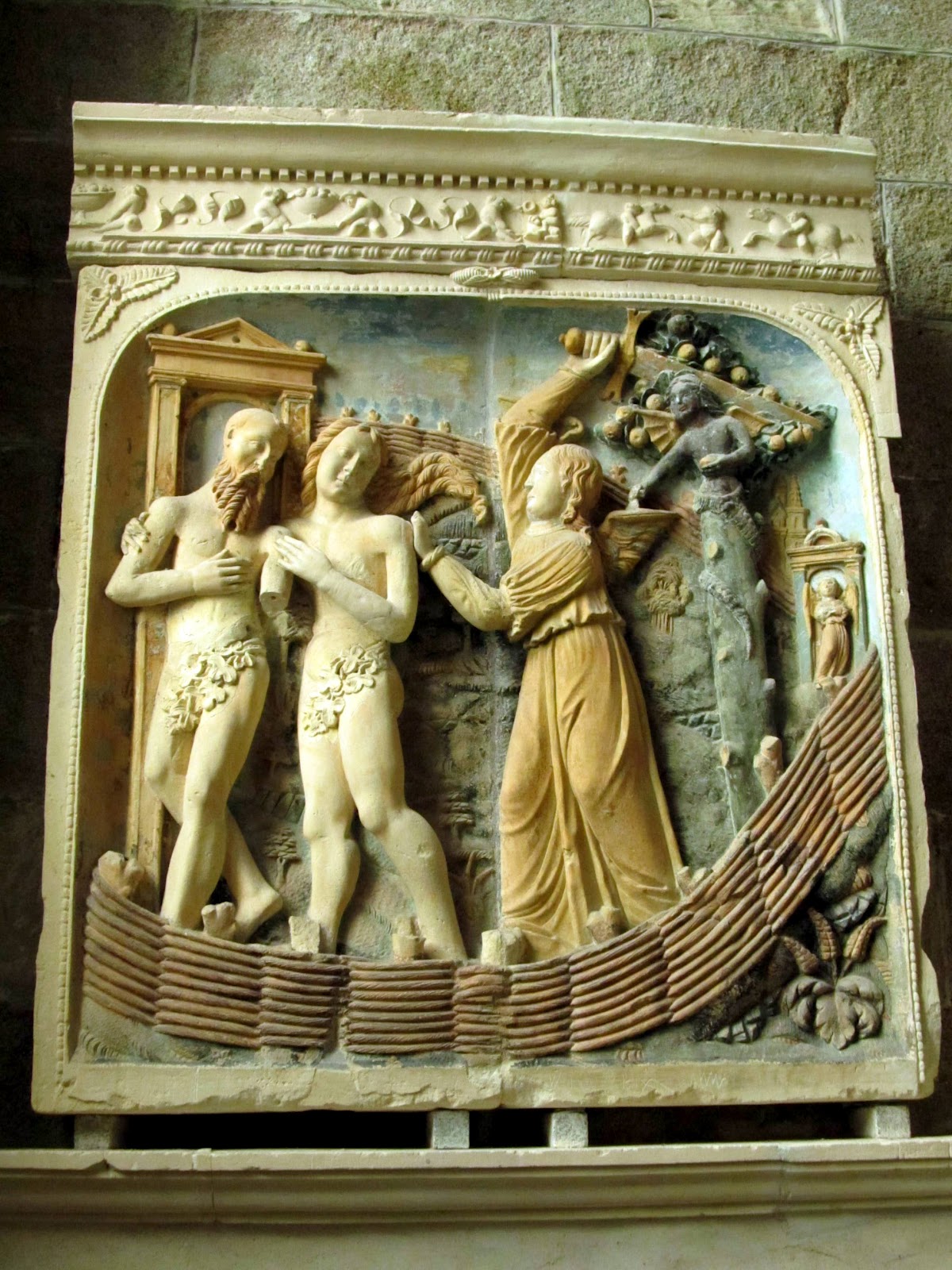
There was little art in entire abbey. Here is a lovely piece -- Adam and Eve.


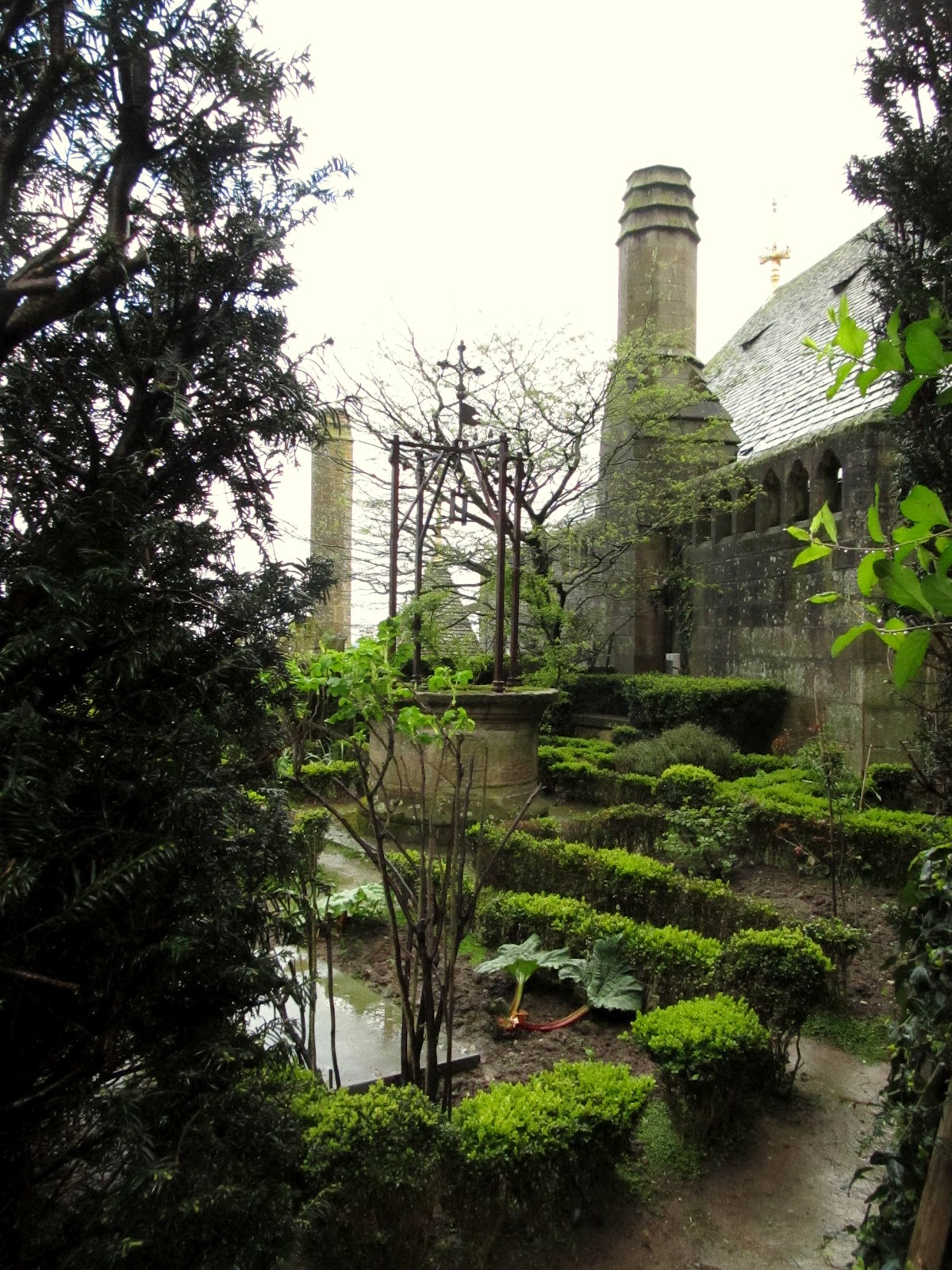
 My favorite area was the cloisters, a bright spot of green and color amidst much stone.


These were simply lovely, in the Gothic style, and offered many lovely and graceful lines...


...handsome sculpture...


...and some good spots for clowning around!


Because of the dampness, there was lots of moss...


...and a small potager or kitchen garden.


And occasionally, bright flowers seemed to grow from out of the rocks.


No matter where one looked, the view was quite spectacular.


Mont Saint-Michel was certainly not my favorite spot in our travels, and frankly, I was relieved to leave this cold, bleak place, with few spots that generated emotional warmth. As I mentioned, I suspect that had to do most with the weather and still being more than a bit jet-lagged. By the time we left it was close to 11 p.m., "Jeanie Time" and we still hadn't had dinner.


But I did leave with admiration for the architectural skill and history, though. It is a massive and fascinating structure and certainly one I'll never forget.

NOTE: Next we'll be going through Brittany. Remember, comments on this post and all of this series of recent vacation posts and the post about Gypsy will be entered in my 800th post drawing!

Popular Posts