Let me preface this to say I sort of hate trash-talking things about my community that are supposed to be good or a big deal. It seems sort of churlish. But Rick and I recently visited our contemporary art museum, the Eli and Edythe Broad Art Museum at Michigan State University.
Let me also say now (and probably again) art -- all art, whether it is the written word, a painting, an installation, a piece of music or that incredibly complicated quilt you have been working on -- is subjective. People will love, hate or feel indifferently about it. And it's all OK.
I tend to take a broad interpretation of art and basically believe pretty much life is art -- that includes gardens, cooking, painting, writing and much more. One can argue art and craft. I think the best artists apply both creativity and technical expertise. And everyone's version of good or bad within that broad category of art will vary based on subjective preference and perhaps objective examination.
So settle in -- there are elements of rant here but the photo part at the beginning is the preface for my concern and overall feeling about this so-called jewel in MSU's crown that I would say is no better than a rhinestone. Or perhaps a nice cubic zirconia.
The meat of my displeasure comes after the photos.
Look hard and you
might see the name of the museum on this panel by the entrance. Or maybe not. It's the Eli and Edythe Broad Art Museum on the Michigan State University campus.
Rick and I decided to spend a gloomy afternoon a week or two ago at the museum. It's been here a few years and we've never seemed to find the time or inclination to visit but we were really bored. And very curious, so off we went and our reactions were baffled to say the least.
I don't think I'm smart enough to like or understand most of the work I saw in this museum. I
know I'm not pretentious enough. Being an art history minor didn't help. At least this one was colorful. I don't understand it but it was a refreshing change of pace.
Don't get me wrong. I like much 20th century art, even the sort of out-there stuff. I'm not big on installations (doesn't any museum recognize good old 2-D art anymore?) But I need it to make sense to me. I don't go to art museums to work hard. Some people do. I go to art museums to enjoy, to savor, to smile.
We weren't smiling. Mostly we were scratching our heads, giggling and screwing our faces into that WTF expression we've all done now and then. Well, if provoking reaction is part of the mission, they got points for that.
I'll start off with the exterior by an architect named Zaha Hadid who died last year. (Personally, I think she was knocked off by a group of East Lansing-ites who are totally pissed off at this building, which rests in the heart of the most lovely of campuses with classic brick buildings.) There might be a place for it over by the performing arts complex which is quite contemporary (and I might add, lovely). But no. To get the money from the Broads, and it was a
lot of money, it had to be in a prominent place. (Hold onto that thought -- there is some meat to this post at the end through our walk through about how money talks...)
Well, it is right in the heart of old campus on the main drag, Grand River Avenue. You can't miss it. Some call it the spaceship. I call it the Big Ugly. Which is also what I call the neighbor's house at the lake. Ironically, if this looked like the neighbor's house, I might be less irritated with it. It's context -- this belongs on Grand River like the neighbor's house belongs on a quiet lake with little cottages. But I digress.
You go in and see this display, below.
OK. A little odd but colorful. I can actually work with this. In the right basement it would be kind of cool.
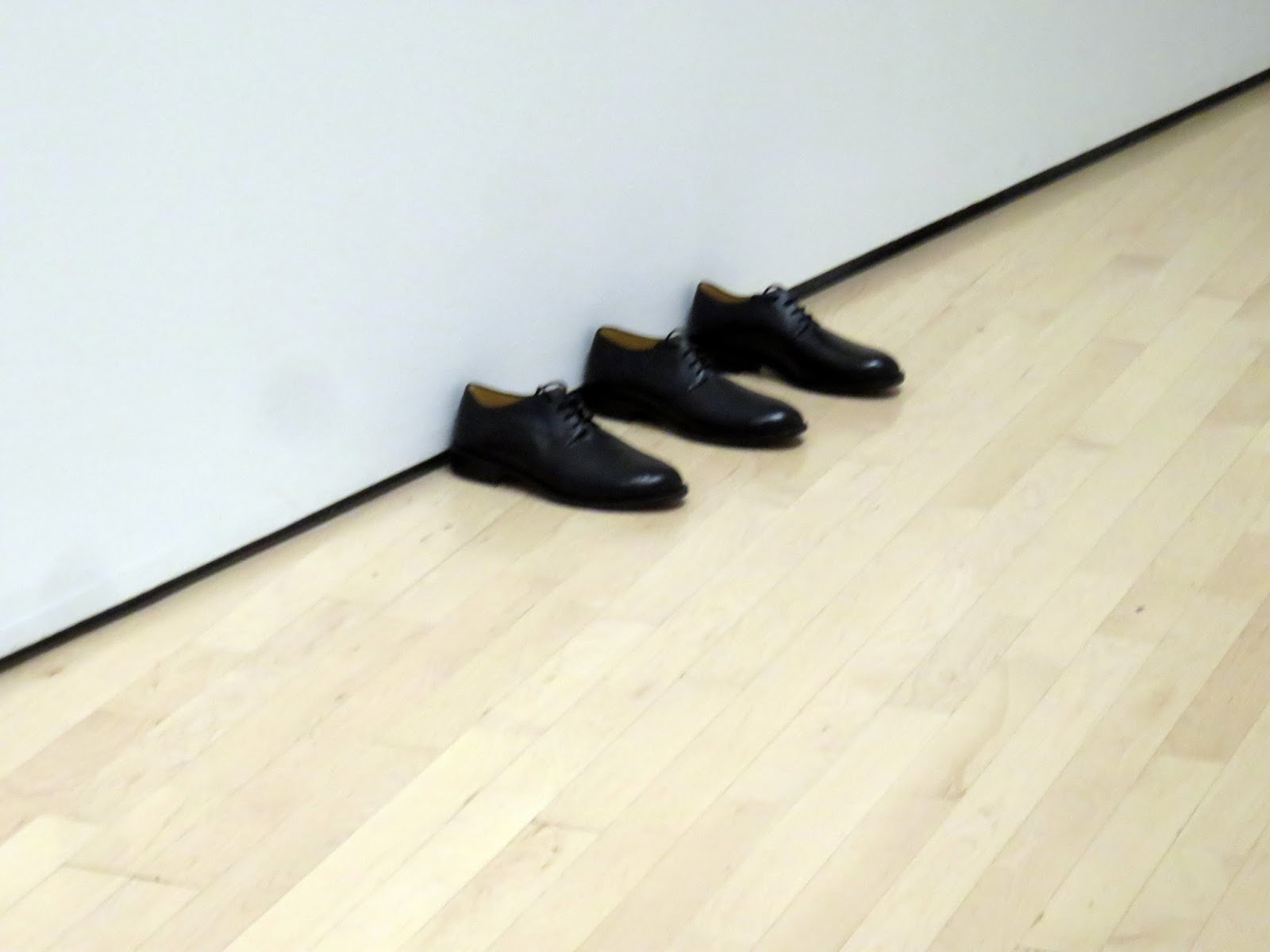
And then these odd shaped rooms that were practically empty. I realized I had this exhibit in my very own home.
Only mine are more artistically (and chaotically) arranged with a bit more color. Maybe I missed my calling.
There was one place where an art student got to pick a favorite piece from the collection (I'm not sure if this was the original collection, which is in hiding or Broad's permanent collection) and highlight it with a statement. I wish I'd taken a photo of it. (I didn't like it but actually, it wasn't horrible.) Only the statement was horrible, which was filled with the pretentiousness of a young artist who is trying too hard to be sophisticated and intellectual.
Now you can say that's OK but to me an artist's statement should not require a dictionary. It should be a clear, concise statement or interpretation of their style or the work on which they are commenting. (This exhibit was next to the comic books -- about a dozen of them. And those made a LOT more sense to me to be in this area than most anything else.)
There was a film that was all computerized of a woman who seemed to do little. Another film with audio of people walking through a home or gallery and talking but all you saw was the exterior of the building. I'm sorry, but I don't have time to stand around and watch that. (I will say some people were laughing, so someone liked it. Art is subjective.)
And this thing -- which I rather liked, but it had no context. And you'll note it was in an empty room. (There was a small projector on the floor that seemed to do nothing -- at least, nothing related.) I'd buy one of those in a heartbeat for the back yard if it didn't cost an arm and a leg. I'm not saying the room should be cluttered but what a waste of space. (Hold onto that thought.)
There was one room I could appreciate. Although, when I walked in and saw this...
...I wasn't so sure. But when I read the clear and concise description of this I thought, "I'll give her a pass on execution because the concept makes sense." But again, you shouldn't
have to read the cliff notes beside the art to get the gist of it.
There was much related to civil rights in this room and here are a few pix.
And some memorabilia.
This one really broke my heart.
The gift shop was small but it wasn't bad.
So, what's this all about?
I repeat. I know that art preference is as subjective as beverage selection. You like all wine but really love the reds. Or you hate the reds and roses, but white is OK. Or you don't drink it at all, you'd rather have a beer or a soda or a malt. We've often said that sometimes beverages are too pretentious -- notes of turpentine, charcoal and chocolate blend with almonds, cherries and kumquats for a unique flavor experience. Yeah, but does it taste good to
you?
So, I understand that someone else is going to see this and think "what far out, thoughtful, deep artists these are." And it will resonate with them. Maybe you.
But mostly, it looks like a waste of space. And there is another, more critical, reason why that is a travesty.
When the Broad opened, MSU's smaller but exquisite Kresge Art Museum was closed. They had a wonderful collection that ranged from the very old to very nice 20th century art. Maybe even 21st century. All of that stuff is either in storage in vaults under the football stadium (ironic) or sold. Who knows?
The Kresge collection included 7,500 works of art and these are not on display. Works by Dali, Calder, Rodin, a Joseph Cornell box, all would be suitable for Broad. Unless it's not contemporary enough.
Initially, the thought was there would be a space for the Kresge Collection at the new museum. It's worth millions of dollars and deserves to be seen (and this is where money talks). But there is no gallery for the historic collection, though supposedly faculty can access it for research. There was some talk of making the collection available online but as of this writing, the links do not work. Means of using them in the museum for historical context do not appear apparent in our visit.
So, remember that empty room with the kind of cool looking pottery jars holding shrubbery? Suppose that -- in a non-cluttered or distracting but enhancing way -- there was a piece or two on each wall from the Kresge Collection that reflected vessels or greenery or nature. It would provide context and use the space more efficiently without the overwhelming volume you get in a truly great museum with a large collection. (If you have ever done the Louvre in an entire day, you either didn't see a thing or had to see a masseuse after for your hips, legs or feet.)
In an
excellent article in the Lansing City Pulse back when the museum was built, writer Lawrence Cosentino interviewed then-director Michael Rush, who told him:
"The founders, Eli and Edythe Broad, gave their money to support a contemporary art museum on the campus of MSU. That's the basic reality. When you have philanthropists entering the situation at that level of giving, which is extraordinary, and it is the donor intent for the museum to be a contemporary one, then that is what we embrace."
But is that right?
To be honest, I fault our university for giving donors so much power. Money talks, whether it is Goldman Sachs in politics or Eli Broad in art, a lobbyist for General Motors or Harvey Weinstein as he sexually assaults women wanting to work in the film industry. And at no place does money talk more than at Michigan State University. It's my alma mater and I love much of it and support financially more than one project/department/service of the U, but I despise the commercialism that seems to take over, on more than one occasion, common sense and the greater good.
From where I sit, there comes a time when that simply isn't right. It's all well and good if it's someone's pet project for a private institution. You want to build your big art museum in our town, great. Knock yourself out -- it's your project.
But Michigan State is a public university (or so they say). And it's aggressive in its fundraising tactics. I know because I worked for a department that had to raise its own money -- but we never caved.
As aggressive and annoying as public broadcasting fundraisers and direct mail can be (and it is, nationwide -- and if we had a TV tax in this country like the Brits, it would probably lighten up... another topic, another time) -- we
never gave in to a program underwriter to influence news coverage or programming. In fact, unless things have changed since I got out of the business, even if we liked the idea and decided to do a television program about it, we couldn't accept underwriting from that person for that program nor could they have editorial control.
If one looks at a museum on a campus it strikes me that if there is only ONE art museum (or history, or whatever topic), and to be in the best interests of the students it serves, the museum should reflect the broadest scope of an area, whether it is art or natural history. Certainly there will may be emphasis on a topic or period as the displays evolve. But a student studying art history should be able to go into the U's only museum and see a works from the 1500s or a work from 2015, study them, form their own opinions.
I always thought that if a friend came to town who had never been here and I was doing the tour, I would add this to the list. I won't. The good news is that within two hours we can go to wonderful, diverse art museums in Detroit, Grand Rapids and Toledo. And that's what we plan to do.