We all have the travel memories we will never forget. It may be the first glimpse of the Eiffel Tower, standing at the foot of a pyramid, looking at the vista from a mountaintop. For me, one that will stand forever is visiting Omaha Beach at the American Cemetery in Colville sur Mere, France, ten years ago this month.
As I stood on the beach and looked up the cliff that the Allied forces had to scale -- while being shelled and avoiding mines -- I was in awe. How in the world did they do it? What gave them the courage?
Ultimately, I think it was because those brave men believed in the cause. Did they know that millions of Jews, homosexuals, gypsies and resistance workers were being gassed by the Nazis? Maybe. Or maybe they were worried about any one country controlling such a significant amount of the world. Or perhaps those from England and France were simply defending their own homeland.
What matters is that thousands of brave young men fought and died for their beliefs and to preserve the values of world peace and tolerance, liberty and democracy.
I wonder what they would say now?
Those who remain for this 75th D-Day Anniversary are now largely in their 90s or older. It will be the last of the 25-year celebrations those veterans will attend. What do they remember, these once-young men? The fear? The camaraderie of being with their fellow soldiers? The fact that they were doing something to help their country and others preserve freedom?
It is easy to forget that those on the other side were also fighting for their country. They were conscripted and required to fight -- many didn't realize what was happening in Germany until it was too late to leave. I'm not sure every man fighting for the Nazis even fully knew or believed in what their leaders were doing. They may have been forced to fight or part of the mob-mentality and frenzy that often comes during polarized times. But these men had mothers and fathers, wives and children, just like the Americans and the Brits. Yet they were in the bunkers on Omaha Beach, shooting at others just their age, with wives and children. Shooting at those who were shooting back.
Are there really winners in war?
On this 75th anniversary of D-Day, I find it important not simply to look back but to look at today and tomorrow as well. Our national and world situation is as bad as it has ever been. When you look at the documentaries that tell of the advent of World War II, the footage is not all that dissimilar from what we see on our news each and every day.
People are divided more significantly than at any other moment in my lifetime, and I came of age during the Civil Rights movement. Strides made in this country in the post-war years have taken a huge hit. Xenophobic attitudes and religious intolerance, racism and the "Me first" attitudes have not just returned but increased. We fought for liberty and freedom and yet some seem quick to deny it to others.
We see it in day to day encounters. Bullying is on the rise in schools. People are angry. There is more lashing out. Less civility.
Even good people who do wonderful things may react in ways that do ourselves, our country, our world no good. We all know the people who faithfully attend church or do good works in their community and are first to help a friend in need. But then they will express racist views, privately or publicly, bully a co-worker or neighbor, will say hateful things. "Not in my neighborhood." "Not in our country." "Those people." Every word of intolerance builds a fence, indeed, a wall, that becomes more and more difficult to scale.
War and hatred doesn't begin with countries. It begins with us. Individuals. Our thoughts. Our deeds. The way we raise our children. The words we say -- in person, in print, tweeting or online. It begins with not listening to others, respecting and valuing others' opinions. Walking in our own shoes and forgetting to think about what it is like to walk in someone else's.
We aren't perfect but we have to try.
People die because of this. They die because someone believes their way is not just better but the only "right" way. That someone may walk into a school and shoot innocent children or take out strangers in a parking lot or at a concert, perhaps feeling angry or slighted or simply because they were told to do so because in doing so, they were defending their rights. And then, people die. That someone may oppose a belief but not see that for others, the choice is different.
Changing attitudes can take time. It isn't easy. Honoring and respecting others who disagree with you can be hard thing to master. Some of us spend a lifetime trying. But trying is all one can do. Doing our best. Day by day. Grains of sand, each a thought. Letting them go so our hand can be open to something more beautiful.
Peace.
So, I ask you on this commemoration of D-Day, to look deep within, as I will do. To seek the "better angels of our nature." To think outside our own boxes, our own families and neighborhoods and look to others. Not just the others we know and understand, but especially those we don't. The poor. The mentally ill. The immigrants. Those whose beliefs are unlike ours but as valuable to them as ours are to us. Those we fought to protect on a grim, wet day seventy-five years ago.
And if you ask, "Why should I?" perhaps this image will remind you. It was a child I saw on Omaha Beach. One small child. One large beach. I don't know her name. I never spoke to her and I never saw her again. But I will never forget her.
This is who I do it for. And all the others.
Everywhere.
(If you are into learning more about D-Day and the experience of visiting these sites, I recommend this beautiful article from The Atlantic. It's a keeper.)
Sharing with: Pink Saturday
The Gypsy Caravan 2023
Showing posts with label Omaha Beach. Show all posts
Wednesday, June 5, 2019
Wednesday, July 8, 2009
Normandy: Sobering, Beautiful
One of the places I had longed to visit in France was Omaha Beach and the Norman countryside. And, I must admit, my reasons for doing so were both historical and personal.
Several years ago, WKAR produced two World War II documentaries, one of which focused on the European theatre. During the course of production, I edited transcripts of many veterans who had served and shared their experiences. (You can see them here if you're interested.)
Several spoke of D-Day and Normandy and the coastal towns they lived and fought in following the invasion. It had indeed become personal.
Our trip to Normandy began early on a Sunday morning, with a fairly long drive, punctuated by stops at town "foires" -- a combination of town flea market and fair with rides and food.
(More on these in another post on flea markets, but I had some fun finds!)
Our first destination was the Omaha Beach Museum. It was fairly small, but with lots of artifacts, clippings, photographs and life-size diarama scenes.
The pieces in the museum told the story --
...from the landing to the resistance.
The emphasis wasn't on the equipment used (although there were certainly examples of the various arms and mortars, uniforms and helmets),
... but of the people who fought so bravely.

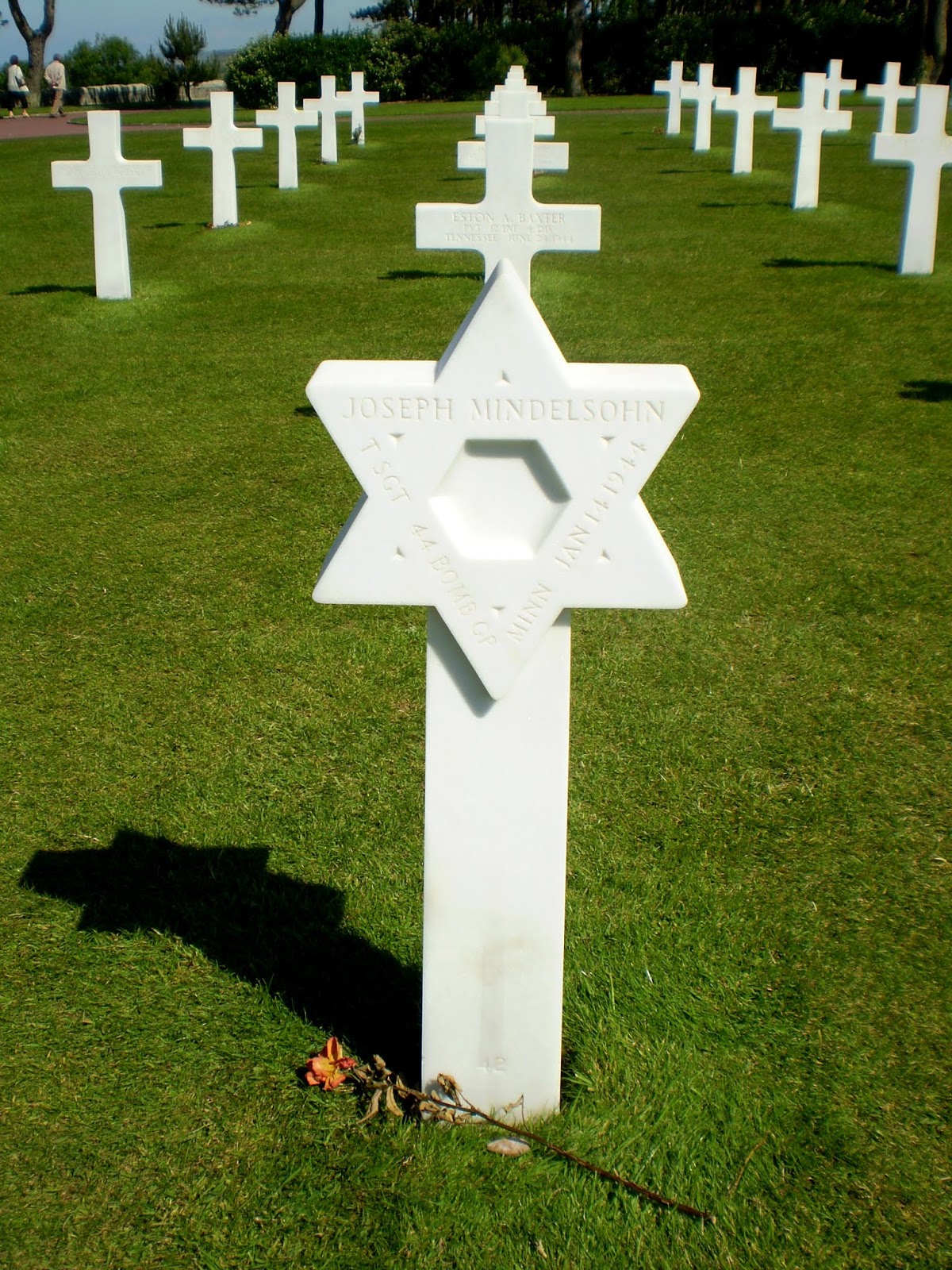
From there we moved on to the American Cemetery. This is truly hallowed ground, and it is impossible not to be moved by the elegant symmetry and simplicity of this final resting place for so many American soldiers.
I was particularly touched by flowers, left behind. Long past their peak, they remain, memorials and testimonials to a given soldier from -- who knows? A family member? A friend? A comrade in arms?
The cemetery is set on a high bluff overlooking Omaha Beach. I'm not sure you can tell from the photo just how far and how high that bluff is, but to be arriving on a boat in wretched weather, knowing the enemy was waiting for you on that bluff had to be frightening indeed.
Think of running up sand dunes -- it isn't easy. Add full fighting gear. It must have been a daunting task.
Now there are steps going down to the beach. Lots of them. Many of the pilgrims to the cemetery went down, as did I. Simply touching the sand, feeling that ground that had touched the feet of soldiers 65 years ago, was a sobering and moving experience.
And for some reason, the only family having a picnic here had a young girl in the family, who delighted in the broad expanse of beach. To me, she represented the purity, the future. After all, isn't it family we fight for most of all?
After leaving Omaha Beach and a stop at a German stronghold, we passed by this old church, named (as so many churches are in France) "Notre Dame."
It had been damaged in the war, and soldiers restored it.
I was rather capitvated by its stone work...
...and the heavy wooden door.
Then it was off to the beach at Arromanches, where some old German boat hulls, rusted and covered with algae, still rest in the waters at the shoreline.
One could easily visualize the soldiers in combat in these treacherous waters.
Our dinner destination was the town of Honfleur, about two hours away, perhaps. It's a port town, with LeHarve on the other side.
We expected it to be the quietly bustling town Jerry remembered. But they were in the middle of a music festival and it was more than a bit manic!
Finally, after 11 p.m., we found an outdoor restaurant on the water.
A look at the menu yielded promising options!

Several years ago, WKAR produced two World War II documentaries, one of which focused on the European theatre. During the course of production, I edited transcripts of many veterans who had served and shared their experiences. (You can see them here if you're interested.)Several spoke of D-Day and Normandy and the coastal towns they lived and fought in following the invasion. It had indeed become personal.
Our trip to Normandy began early on a Sunday morning, with a fairly long drive, punctuated by stops at town "foires" -- a combination of town flea market and fair with rides and food.
(More on these in another post on flea markets, but I had some fun finds!)
Our first destination was the Omaha Beach Museum. It was fairly small, but with lots of artifacts, clippings, photographs and life-size diarama scenes.
The pieces in the museum told the story --
...from the landing to the resistance.
The emphasis wasn't on the equipment used (although there were certainly examples of the various arms and mortars, uniforms and helmets),
... but of the people who fought so bravely.
From there we moved on to the American Cemetery. This is truly hallowed ground, and it is impossible not to be moved by the elegant symmetry and simplicity of this final resting place for so many American soldiers.
I was particularly touched by flowers, left behind. Long past their peak, they remain, memorials and testimonials to a given soldier from -- who knows? A family member? A friend? A comrade in arms?
The cemetery is set on a high bluff overlooking Omaha Beach. I'm not sure you can tell from the photo just how far and how high that bluff is, but to be arriving on a boat in wretched weather, knowing the enemy was waiting for you on that bluff had to be frightening indeed.
Think of running up sand dunes -- it isn't easy. Add full fighting gear. It must have been a daunting task.
Now there are steps going down to the beach. Lots of them. Many of the pilgrims to the cemetery went down, as did I. Simply touching the sand, feeling that ground that had touched the feet of soldiers 65 years ago, was a sobering and moving experience.
And for some reason, the only family having a picnic here had a young girl in the family, who delighted in the broad expanse of beach. To me, she represented the purity, the future. After all, isn't it family we fight for most of all?
After leaving Omaha Beach and a stop at a German stronghold, we passed by this old church, named (as so many churches are in France) "Notre Dame."
It had been damaged in the war, and soldiers restored it.
I was rather capitvated by its stone work...
...and the heavy wooden door.
Then it was off to the beach at Arromanches, where some old German boat hulls, rusted and covered with algae, still rest in the waters at the shoreline.
One could easily visualize the soldiers in combat in these treacherous waters.
Our dinner destination was the town of Honfleur, about two hours away, perhaps. It's a port town, with LeHarve on the other side.
We expected it to be the quietly bustling town Jerry remembered. But they were in the middle of a music festival and it was more than a bit manic!
Finally, after 11 p.m., we found an outdoor restaurant on the water.
A look at the menu yielded promising options!
And of course, I had to sample the escargot! I'd been dying to try snails since long before my trip began, inspired by a commentary in Peter Mayle's book "French Lessons."
And oh, he was so very right! Succulent, delicious. Garlic and herbs with that bit of snail. I'd do it again in a heartbeat!
Things I Learned Today:
Snails. Yum.
The writing "s/" means "sur" or "on the" -- "Sur La Mer" might be written s/Mer. Lots of the towns here were on the sea.
There are several women (nurses) buried in the American Cemetery.
I really never expected to be so moved as I was by a place such as this.
The best raspberries I've ever eaten were found at a foire en route to Normandy. I wish I had more!
And oh, he was so very right! Succulent, delicious. Garlic and herbs with that bit of snail. I'd do it again in a heartbeat!Things I Learned Today:
Snails. Yum.
The writing "s/" means "sur" or "on the" -- "Sur La Mer" might be written s/Mer. Lots of the towns here were on the sea.
There are several women (nurses) buried in the American Cemetery.
I really never expected to be so moved as I was by a place such as this.
The best raspberries I've ever eaten were found at a foire en route to Normandy. I wish I had more!
Subscribe to:
Posts (Atom)
Popular Posts
-
Rick diligently practices his classical guitar every day. And guess what? He gets better and better. In the summer, I paint every day. And g...
-
Shortly after what I view as world lockdown began, March 11, 2020 (the date would no doubt vary from place to place and person to person), I...
-
I'm a collector. Lots of us are. We pick several (OK, maybe more than several) things that particularly appeal to us and build a collec...


