Showing posts with label Norman Rockwell. Show all posts

Saturday, April 1, 2017

The Four Freedoms

Our recent visit to the Norman Rockwell Museum in Stockbridge, MA, brought us face to face with some of the artist's most renowned works. Perhaps none of those pieces are more recognized or painted with such care as his "Four Freedoms" series.


The Four Freedoms were given voice in an address by President Franklin D. Roosevelt in 1941 as much of the world was at war and within a year, the U.S. would be as well. He proposed four basic freedoms that "people everywhere in the world" ought to enjoy: Freedom of Speech, Freedom of Worship, Freedom from Want and Freedom from Fear. Two of these freedoms (religion and speech) are protected in the U.S. Constitution by the First Amendment. 


Rockwell was already a respected and well-known artist when Roosevelt made the Four Freedoms speech. As part of a career that would later include numerous paintings depicting World War II on both the home front and war zone settings, he viewed interpreting them in illustration as a wonderful opportunity. While he was considered apolitical, he had strong feelings regarding kindness and humanity, feelings he would repeatedly express in his work. 


The paintings were done in 1943, two years after the speech and after America entered the war. The series took seven months to complete. Rick calls them "the icons" and they are, representing both popularity and achievement. Measuring about 46x35 inches, the paintings were not only featured in "Saturday Evening Post" but went on a touring exhibition that accompanied the sale of war bonds, raising more than $132 million.

That said, the Office of War Information was a reluctant participant until after the paintings were published in the Post and the requests for reprints was overwhelming.


The series was inspired not only by Roosevelt's words but from a town meeting Rockwell had attended during which a man stood up to express a dissenting opinion and was respectfully listened to. This became the setting for "Freedom of Speech," using neighbor Jim Martin as his model.

He used both live models and photographs. "Freedom from Want"  has become known as "The Thanksgiving Painting" and included Rockwell's family members and friends at home in Arlington, Vermont. It is the family's cook who is seen serving the turkey. The painting was done using photographs of the models.


Jim Martin, who is seen in this painting sitting next to the little girl near the head of the table on the left was a frequently used model and is in all four paintings, most prominently in "Freedom from Fear," acting as the father.


In the scene, a couple holding a newspaper with the day's frightening  headlines as they watch over their sleeping child.


"Freedom of Worship" was considered the most controversial, featuring a number of faiths in prayer together. But by and large, the series was a success because the paintings spoke to the public in a way they could understand, using the values of unity and respect. Because the demographics of the "Saturday Evening Post" did not, at the time, have a large African-American or Islamic readership, the black woman and the gentleman in the Fez are in the corners of the painting, present but more discreet.


Whether one considered Rockwell "corny" or "down home" or a skilled artist adept at chronicling daily life, the public welcomed the works, which were to become the artist's most famous.

These Four Freedoms has never been more significant than today,  when so many feel threatened on any number of levels. Freedom of Speech is often curtailed and there is rarely respectful listening, while those in marches or protests often experience physical threats. In some states, bills are being introduced to restrict freedom of speech and right to assemble under the guise of protecting citizens (HERE and thanks, Mae, for drawing my attention to this). Religious groups are fighting threats of terror domestically and racism based on religion appears to be increasing. The "Not in my backyard" feeling has risen, challenging our country's role in welcoming refugees. Many in our own country suffer from want daily, lacking adequate food and nutrition (and, should you like to carry "want" beyond that, medical care, and lack of social services.) I know I am not the only one who has felt fear and anxiety, wondering if today or tomorrow will be the first day of a new military escalation.

In light of that, I leave you with the words of FDR in his 1941 speech, in case you didn't listen above!
"In the future days, which we seek to make secure, we look forward to a world founded upon four essential human freedoms. The first is freedom of speech and expression—everywhere in the world. The second is freedom of every person to worship God in his own way—everywhere in the world. The third is freedom from want—which, translated into world terms, means economic understandings which will secure to every nation a healthy peacetime life for its inhabitants—everywhere in the world.

The fourth is freedom from fear—which, translated into world terms, means a world-wide reduction of armaments to such a point and in such a thorough fashion that no nation will be in a position to commit an act of physical aggression against any neighbor—anywhere in the world.
That is no vision of a distant millennium. It is a definite basis for a kind of world attainable in our own time and generation. That kind of world is the very antithesis of the so-called new order of tyranny which the dictators seek to create with the crash of a bomb."—Franklin D. Roosevelt, excerpted from the State of the Union Address to the Congress, January 6, 1941

For more information, check out this informative Wikipedia article on the Four Freedoms paintings along with the Norman Rockwell Museum which has much information on the artist and his works (not to mention a fabulous gift shop!)

For another perspective on the Four Freedoms themselves, please visit Mae right HERE!

Sunday, March 19, 2017

"I Love to Tell Stories in Pictures."

The Norman Rockwell Museum is located in the town of Stockbridge in the Berkshires of Western Massachusetts. If you are a fan of this remarkable artist, as I am, it's the place to be to not only learn more about the artist but to see many of his most famous paintings "in person." They remind of us a gentler time, and as I walked through I thought more than once that I wished that I was living in that gentler time -- although as you'll see, those times weren't perfect either, as he captured details of war and racial unrest and its effects on everyday people.


"I love to tell stories in pictures," he says in the video that highlights his life. It's something he does well and is greatly meticulous in doing so.


Take the photos above and below, for example. In the photo above, the first version telling the story of a little boy running away from home, you'll note that he is in a more polished restaurant with a state trooper. (You'll also note it is unfinished -- check out the detail on the stools and the runaway knapsack and compare with the photo below).


This one is completed -- but also more "realistic." The officer is now a town officer (that detail is told in the arm patch), the diner more something like you would find in a small town. This little guy has run away from home -- but hasn't gone too far yet. And chances are, this kindly officer will return him to his home, or the friendly fountain cook will give the child's mom and dad a quiet call for a pick-up.

One of his most famous paintings was done for "Look" magazine and documents Ruby Bridges on her first day of school after desegregation, begins escorted by U.S. Marshals. Note the smashed tomato on the wall.


Another in the series tells a story of a family discovering their new neighbors. Will the children become friends? One hopes so. Will the woman peeking out of the curtain in the upper left accept the new family? One can only hope that as well.


Rockwell often used his neighbors as models and frequently worked from photos. He also, as filmmaker Alfred Hitchcock did, often put himself in the story. In the painting below you see him bringing his artwork to the newspaper in Monroe County, Iowa, young and enthused.


Rockwell stories of daily life -- a couple getting a marriage certificate...


Detail from an enormous painting of a family at the doctor's office. This was painted during war time and you can see the doctor has someone serving.


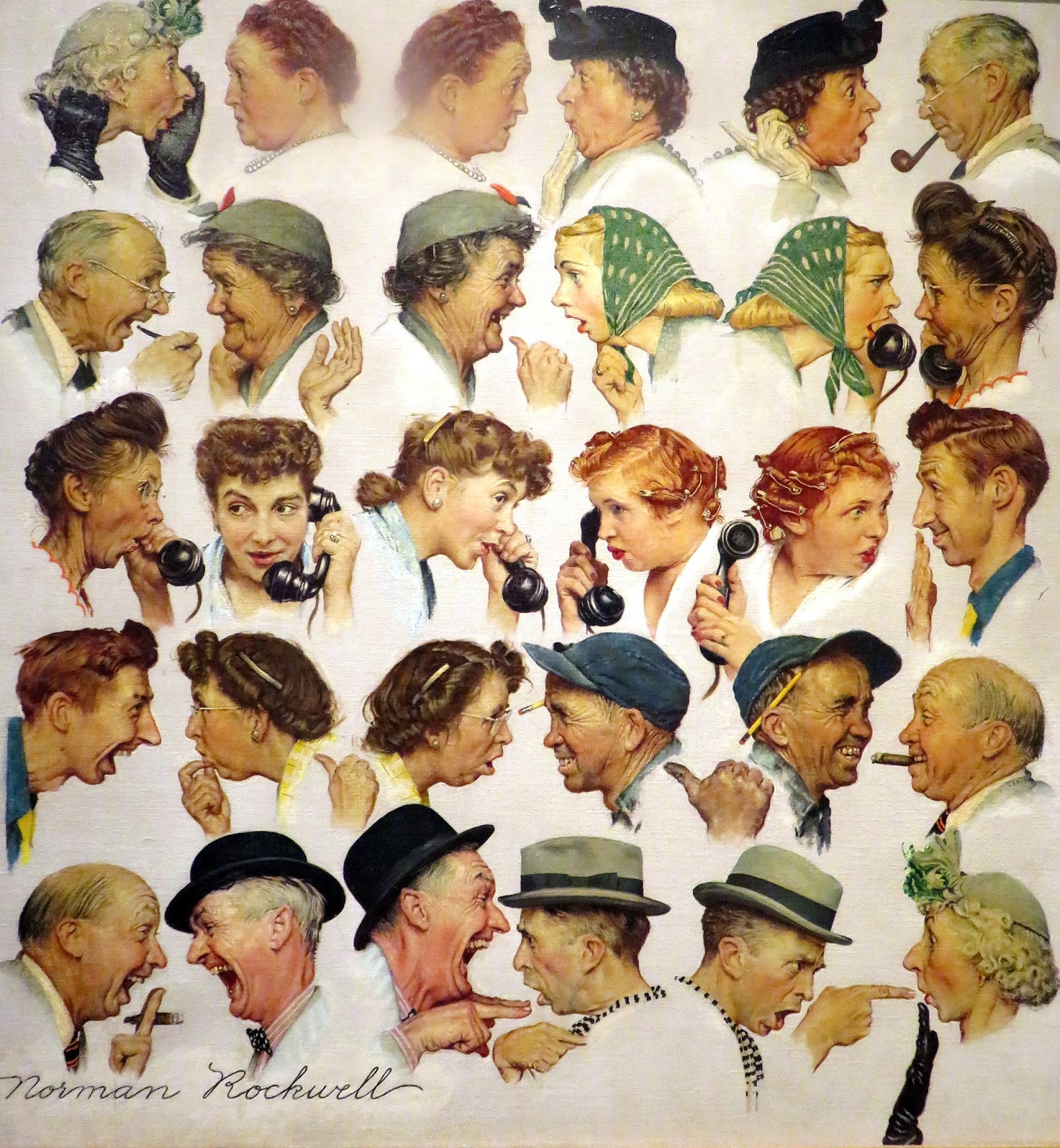
The famous telephone tree! Do you think Lily Tomlin might have taken her Ernestine costume from this painting?


And one of my favorites -- "A Day in the Life of a Girl."


We also get to see his initial sketches for that painting.


Rockwell's career included working with Boy's Life Magazine (many of his scouting paintings are at the National Boy Scout Museum in Dallas through May 2016, after which the museum will be closed; you can see more on that HERE) and the collection at Stockbridge on this topic is minimal. But you'll see many of his popular Saturday Evening Post covers in a Cover Gallery.


It was fun to see this one in person, as well as note some of the authors featured on the various  covers -- F. Scott Fitzgerald, Agatha Christie and many other famous names.


You'll also find large paintings done to illustrate stories in a variety of magazines, including this one. The story tells of a woman who takes her granddaughter on a trip into town to buy cloth for a dress. This one, as are several others in the collection, very long and narrow.


I loved this one. Always have, always will. The gentle details -- the make-up on the floor, the movie magazine, the doll tossed aside. This thoughtful study of the young girl resonates with heart and hope.


He also takes his gentle pokes at his own profession, everything from creative block...


...to the study of art itself.


One of my favorites is actually a fairly small painting, though it is very long. It focuses on Stockbridge Main Street at Christmas.


It took Rockwell more than ten years to finish this painting and he had to add a 1960s car to update it from his original. Depicting a typical rural New England town, Stockbridge itself looks much the same.


The studio above the general store in the center of the painting was once Rockwell's studio, as was the little red building on the far right, nestled in the trees at another point in his career. You'll also see the Red Lion Inn on the right of the original photo of the full painting.


We decided to check out the town of Stockbridge after our visit (and I'll have a bit more about our visit to the museum in future posts, including the Hanna and Barbera exhibition and Rockwell's famous Four Freedoms.) We wanted to step into the Red Lion Inn, which you see on the far right of the full photo (up a couple of pictures!)


It's simply lovely. The kind of classic hotel that has nooks and crannies in the lobby and adjacent areas where you can play a game of chess, read a book or check out the art and interesting pieces of furniture and accessories.


I loved this big rocking horse!


If it wasn't mid afternoon, we might have stopped into the pub! It was charming and struck me as a classic Old English pub.


How I would have loved to go up those steps to a cozy room! Maybe someday.


There is much more to share but for now, settle into one of these paintings and make up your own story. What a writing prompt!

I'm sharing this post with Monday Social! Check out the delightful links.

Tuesday, January 31, 2017

Norman Rockwell and the Art of Scouting

I'm going to say this first thing: If you are in the Dallas area, you want a wonderful attraction that includes a significantly large collection of Norman Rockwell paintings, exhibits and interactive activities, all with free admission (Sundays and Mondays; admission other days), check out the National Scouting Museum in Irving on Walnut Ridge Road, near MacArthur Blvd.


And check it out fast because in May the non-art part of the museum is moving to Cimarron, NM and to the Philmont Scout Camp.


Rick, his mom and I visited this before he and I headed home. This post is in two parts and the first focuses on the art collection. You'll see numerous photos of Rockwell art in this post. If the topic interests you, check out the photo captions for more details.

The Scoutmaster was painted in 1954. The scouts had him go back and revamp the tents because his first time through the sides of the tents were missing (like an Army tent). The scout tents have narrow sides at the bottom of the A-frame
 Many Norman Rockwell originals are included along with art by Joseph Cstari, artist for the scouts.


The blog Illustration Art posted their answer to the difference between fine art and illustration. From the point of the writer, there is no difference apart from the way the artist is paid. (Often fine art is done with no direct buyer in line, while illustration tends to be done for magazines, books or other printed material and the artist is paid by the job. There are, of course exceptions.)

(By the way, if you are into this, check out the article. It's pretty interesting!)

I didn't get the name on this one but our guide reminded us that the eyes of the two scouts in front tend to follow you no matter where you stand. And yes, they do.
I was glad to read this because I sometimes hear illustrators put down and it is so unfair. Their work tells stories and in the case of Norman Rockwell (and Joseph Cstari) no one can say the work is shoddy.

"Mighty Proud" shows a young scout moving up from Cubs into his Boy Scout uniform. You can tell the family is as thrilled as he is!
 Norman Rockwell has always been a favorite of mine. He captures the human spirit in fine detail -- the joys, the concerns, the pleasures and the perils of life.

"Forward America" was an illustration for the 1951 Brown & Bigelow Boy Scout calendar. It is unique in portraying scouts from different programs offered at the time -- Explorer, Cub, Boy Scout, Air Scout and Sea Scout (the latter two now defunct).

He is perhaps best known for his illustrations in Saturday Evening Post but I didn't know his first job was doing art for the Boy Scouts. He did numerous pieces of calendar art, including Boy Scout Calendars for the Brown and Bigelow company, among his other projects.


Rockwell's life wasn't a particularly happy one. He suffered from depression and his second wife also spent time in a psychiatric clinic. His work was dismissed by serious art critics until later in his life and his work was often considered sentimental, idealistic and "not serious." It wasn't until later in his life when he chose more serious subjects for his work that he began to claim a wider respect.


I am a sucker for Rockwell's work, having tried with little success to paint something with the complete detail, soul and personality that would be a worthy try. (Maybe it isn't my style or medium but oh, I love it!) I love the heart and energy and sheer joy.


I loved that he used the people he knew as his models and painted from photographs, often setting up an elaborate scene or going out into the field to set the stage.

"Men of Tomorrow" was an oil done for the 1948 calendar. The Cub Scout in the foreground was modeled by Peter Rockwell, the artist's younger son. His next-door neighbor was featured as well, posing for six figures. He held hiking poses in the studio while posing on wooden plants to simulate the walking effect. He was paid five dollars for his work. Our guide told us that the first figure was doing the tradition scout "good deed" by carrying the hat of the boy carrying the canoe. He also explained that some Rockwell's have the script signature, not his preferred version in his later work..
We enjoyed a number of his paintings at the musem. Our guide, 90-year-old Paul Ernst, had met Rockwell during his many years working with the Boy Scouts. If you happen to stop by (we went on a free Monday), I hope you have the opportunity to meet this remarkable man. He knew the work, he knew the stories, he knew the myths and the methods. We couldn't have asked for anyone more personable or knowledgeable to be our guide.


For example, check out the texture on this painting. Traditionally Rockwell painted in a very smooth style.


But here you will note texture and use of the palette knife in the clouds and ground.


He also pointed out to us that while Rockwell had two signatures, the block letters here were his preferred version.


The artist often included dogs in his paintings and not surprisingly many of those he used were his own.


I loved this piece, "The Homecoming," capturing the family's enthusiasm as they welcome their home from camp. Note the energy, the partial leg and skirt of someone at the top of the steps. And if you look carefully, you will see that the step angle changes somewhat from top to bottom. Clearly, he was working from two different photos for the steps.


I really loved the detail on the wallpaper.


And check out the detail on the arm patch.


Of course, it had a Lizzie cat, so what's not to love?


Rockwell worked for the Boy Scouts and also did art for their handbooks. If you note in the photo below, the book cover is not yet painted. He hadn't decided what he wanted to do.


Here is the finished version as it appeared on the handbook.


Then there was this one, another calendar piece.


You can see the tips of the shoes, the humanity of the aging sailor...


and the detail of the globe.


Detail. Rockwell does it well. Rick had me be sure to capture this painting. (Pictured as a detail)Note the fingernails. They've been out and about!


Finally, I would be remiss if I didn't show some of the work of another artist who worked with the Scouts after Rockwell. Joseph Cstari is, I think, his equal in skill.


There isn't quite enough art to catch the "heart" of the work. I won't say it doesn't exist, but I see these less as telling a story than as illustrating a point.


But done well indeed.


So, two thumbs up and a big Boy Scout salute to this museum. But if you want to see this collection, get there soon!

Not a scouting painting, yet one of my favorites!
And ask for Paul!

Popular Posts