How are you enjoying "life inside"? Are you coping with shortages of toilet paper, cleaning products or your favorite food? Have you managed to find your own space within your home to do work, educate your children or just get away for a bit? Have you had more than a few temper flare-ups, sibling rivalries or tearful moments? Have you been imagining days past, remembering (or anticipating) lovely vacations somewhere far away from home?
 |
| Anne Frank House in Amsterdam is the building to the right of the one with the pointed roof. |
Are you or someone in your family journaling your experiences, either online or on paper?
 |
| Anne Frank's Diary |
At times like this, it's useful to remember that we weren't the first who had to go into "hiding." And by comparison, we have it pretty good.
A dear friend who long ago directed me in "Diary of Anne Frank" sent this wonderful Life special edition that is currently on news stands about the young woman whose diary influenced generations beyond her.
In 2009, when Rick and I first went to Europe, we were fortunate to be able to tour the Anne Frank House in Amsterdam. It left an indelible impression, partly because I'd been inspired by her story since it was required reading in junior high and partly because how could one not be affected?
 |
| Margot, Otto, Anne and Edith Frank, shortly before going into hiding. |
The story of Anne Frank and her family and fellow hiding residents is instructive in these days of social distance for many of us. It certainly resonates for me. Apart from Rick, I really am not seeing people. Unless I'm taking a walk or in my yard, I am inside. (I should also add that this isn't much of a hardship for me and not that much unlike my life before quarantine.) Last night we had our first Zoom Virtual Happy Hour. It felt good to "see" other people, even though most of our conversation was about CV19.
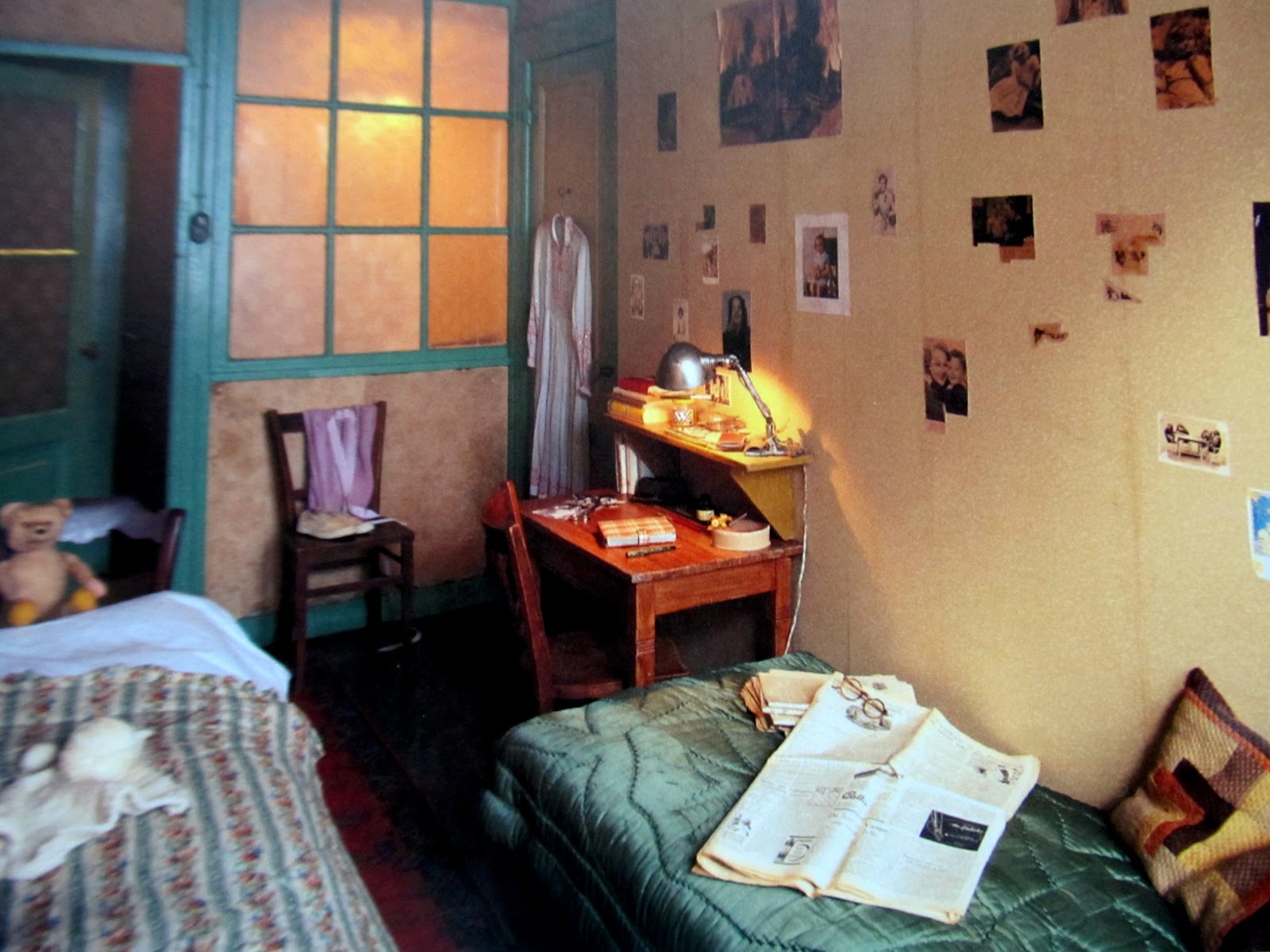
But when I think back to the Anne Frank House, I remember the differences they faced. First of all, there were eight people in a very few rooms. No one, apart from young Peter, had their own private space. Each sleeping space was shared by at least one other person.
 |
| A re-creation of the room Anne shared with the dentist, known in the book as Mr. Dussell. |
While I know many families may be in small homes or apartments, there are also many of us who are isolated are in a home where we will have our own spot to go if we need to be alone. We are used to adjustable heat or if it's hot, air conditioning. They couldn't open a window, no matter how hot it was. And the heat was not adequate in the cold Netherlands winter.
 |
| A model of the Anne Frank House -- warehouse on the left, upper floors on the right were where Anne and her family hid. |
And of course, they couldn't go for a walk or a bicycle ride, our out to rake leaves and get the garden ready for spring. Anne's closest look to the outside was a window in the attic of the building in which they were hidden.
 |
| This was Anne's only window to the world. |
They had little food. Moments in the diary recall their having only a few potatoes to share amongst the eight of them. Bread could be scarce, as could meat. In a rare moment of festivities, Miep, their caretaker, saved ration cards to make them a very small cake. What would they think of supermarket wars over a package of toilet paper?
Their entertainment was restricted to books and puzzles. For one Hanukkah gift, Anne erased the answers from her sister's crossword puzzle book so she could do them again. What would they think of cable, 24 hour streaming, books online or on tablets?
 |
| The entry to Anne's hiding place was behind this book case on the upper floors of an office building. |
Communication? They relied on an unpredictable wireless but by and large their window to the world was wrapped up in the visits of the people who put their lives on the line to bring them food or updates on the war. There was no 24-hour news cycle or online newspapers.
They had to be absolutely still during the hours workers were in the building, below them. They couldn't use the bathroom and even a cough could bring the Gestapo.
The consequences of "breaking the rules" for Anne and her family? A brutal death, if not instantly, then through the excruciating brutality of the concentration camps, in which all but her father died.
 |
| Anne's room; the faded photos she collected of film stars remain. |
I hope this is as close to an Anne Frank moment as we will ever get. They were targets to something known -- discovery by the Nazis. We are targets to something about which we know but that cannot be seen, the virus. In its own way it is as dangerous. As a simple cough could lead to Anne's death, that same simple cough could lead to ours. The virus can, it has and it will continue to kill thousands of people in the next weeks. It does not discriminate, as the Nazis did. Good men, women and children are dying and so are the bad, regardless of age, race, gender or ethnicity.
And like Anne's family, there are the helpers. Those who are staffing the medical units, the grocery store and warehouse workers, truck drivers, pharmacists, journalists, restaurant delivery/take-out providers, utilities workers who are working on the infrastructure. There are the volunteers at food banks and those who brave the grocery store to get food for their family, neighbors and friends. Scientists are in their labs, working hard to create vaccines. Last night a friend picked up their groceries at curbside from one of the large Meijer stores here. The young woman who did their shopping -- who put her life on the line so they could have food -- was working without gloves, masks or wipes provided by the store. They gave her the half-bottle of hand sanitizer they had in their car. She cried.
People like this -- who go on the front lines for us -- represent the best of us.
 |
| Mr. Frank's office colleagues provided food and shelter to the Franks and their friends for more than two years. |
But we can be our best too. We can protect ourselves and others by staying home. Washing hands. Sterilizing our spaces. We can watch movies on Netflix, read books, engage in video games, blogging, Zoom chats with family and friends. The kids can keep up with lessons online and if they're antsy can get out for a walk or play in the yard.
We probably have enough food to eat. Granted, it may not be exactly the food we want that night, we might be missing an ingredient to make a favorite dish. But we can eat. (At least, many of us can. There is a significant portion of the population that relies on food banks, which are running out of food.)
But that is "some of us." For others, challenges will multiply. Because of the massive unemployment, until some form of stimulus arrives, there will be many hungry families. Rents will be due with no money to pay. Crime will probably rise in many areas because of financial desperation. We have a global society that will be experiencing unprecedented collective grief as friends and loved ones die.
We all know that isolation can be challenging. We know that people are dying, and within a month or so, at least one person we know directly or one degree removed will either contract the virus or die. We are anxious. We may have bad dreams that wake us. (Well, I am, anyway.)
We have limited tools with which we can fight. Soap. Hand sanitizer. Our own ability to keep a safe distance. Staying home.
 |
| Anne could hear the bells from this nearby church. |
But we also have better tools to cope with it than ever before. Things that can help staying home easier than ever before. And if we stay home now, then one day we can be out again amongst many people, traveling the world if we wish.
 |
| Amsterdam. No hiding. No spatial distance required. |
This is our Anne Frank moment. Please Stay Home. And Stay Well.